
This article is published by Prometheuz Health, a men's health telehealth provider. Prometheuz offers FDA-approved TRT evaluation and prescriptions through a licensed, LegitScript-certified process. It reflects the commercial interests of the publisher. Content is for educational purposes only. It does not replace evaluation by your own licensed healthcare provider.
Quick answer: Peptide therapy uses short amino acid chains to trigger specific signals in the body - hormone release, cellular energy production, nutrient metabolism. Some peptides are FDA-approved, while many sold for wellness or anti-aging aren't. NAD+, Sermorelin, and B12-MIC work differently and carry different levels of evidence.
What Is Peptide Therapy?
Peptide therapy is the use of peptides, short chains of amino acids, to trigger a specific biological signal rather than replace a hormone or nutrient outright.
Peptides. These are chains of 2 to 50 amino acids. Below that length, they're amino acids; above it, they're generally classified as proteins.
Receptor binding. Most therapeutic peptides work by binding to a receptor on a cell's surface, which triggers a downstream signal, like releasing a hormone or activating an enzyme pathway.
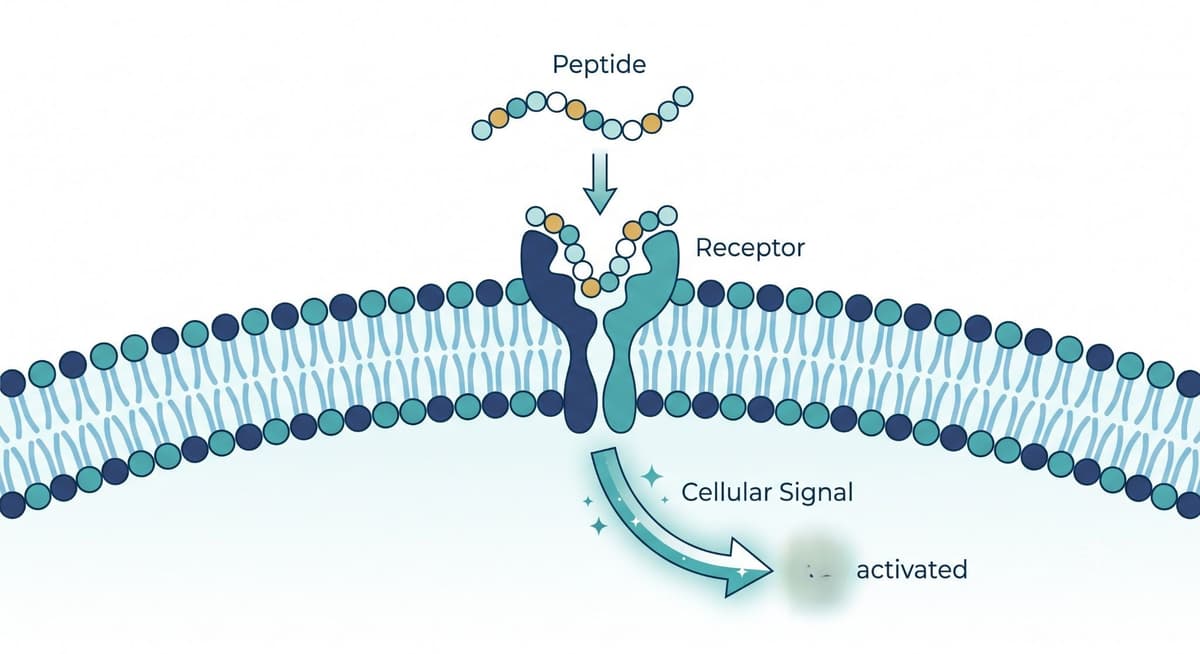 This receptor-based signaling is why peptides are often described as messengers rather than raw materials. A small peptide can trigger a large downstream effect without needing to be present in large amounts.
What Types of Peptide Therapy Exist?
| Category What it targets Examples |
| Metabolic / weight | Appetite, blood sugar, fat metabolism | Semaglutide (GLP-1), tirzepatide |
| Growth hormone signaling | GH release, body composition, recovery | Sermorelin, CJC-1295, ipamorelin |
| Cellular energy | Mitochondrial function, DNA repair | NAD+, MitoQ |
| Methylation / lipotropic support | Methylation, fat metabolism | B12-MIC, B complex injections |
| Tissue repair | Healing, inflammation, connective tissue | BPC-157, TB-500 |
| Cognitive / nootropic | Focus, mood, neuroprotection | Selank, Dihexa |
Not All Peptides Are Regulated the Same Way
This is the part most patients don't get told upfront, and it's the single most important thing to understand before starting peptide therapy.
| Category Example Regulatory Status |
| FDA-approved for a specific use | Insulin, semaglutide (GLP-1) | Full FDA approval, extensive clinical trial data |
| Formerly FDA-approved, now compounded off-label | Sermorelin (Geref) | FDA approved the original product for pediatric growth hormone deficiency; it was voluntarily discontinued in 2008 for commercial reasons, not safety. Compounded versions are prescribed off-label today. |
| Never FDA-approved; sold as a wellness injection or infusion | NAD+ | Not FDA-approved for any anti-aging or wellness indication. Human outcome data is limited. |
| FDA-approved ingredient, unapproved combination use | Vitamin B12 in a B12-MIC shot | B12 itself is FDA-approved for treating diagnosed deficiency. The B12-MIC (methionine, inositol, choline) combination is off-label and not FDA-evaluated as a lipotropic or general-energy treatment. |
Prescribing something off-label is legal and common in medicine. It just means the specific use hasn't gone through FDA trials, so the evidence is thinner and should be discussed with your provider.
What Are the Potential Benefits of Peptide Therapy?
Benefits depend entirely on which peptide is being used, why it's being used, and whether a real deficiency or a diagnosed condition is being addressed. In general, research points to potential support in these areas:
- Hormone signaling. Some peptides prompt the body to release more of its own hormone, rather than supplying it directly.
- Cellular energy metabolism. Peptides and cofactors involved in mitochondrial function may support how efficiently cells produce energy.
- Nutrient deficiency correction. When a documented deficiency exists, replacing the missing nutrient can meaningfully improve symptoms like fatigue.
- Recovery support. Some peptides are studied for tissue repair and recovery, though the quality of evidence varies significantly by compound.
None of this means guaranteed results. Evidence ranges from strong (FDA-approved indications) to preliminary (most wellness-marketed peptides), and results vary by individual.
Three Peptide-Based Options: What Each One Actually Targets
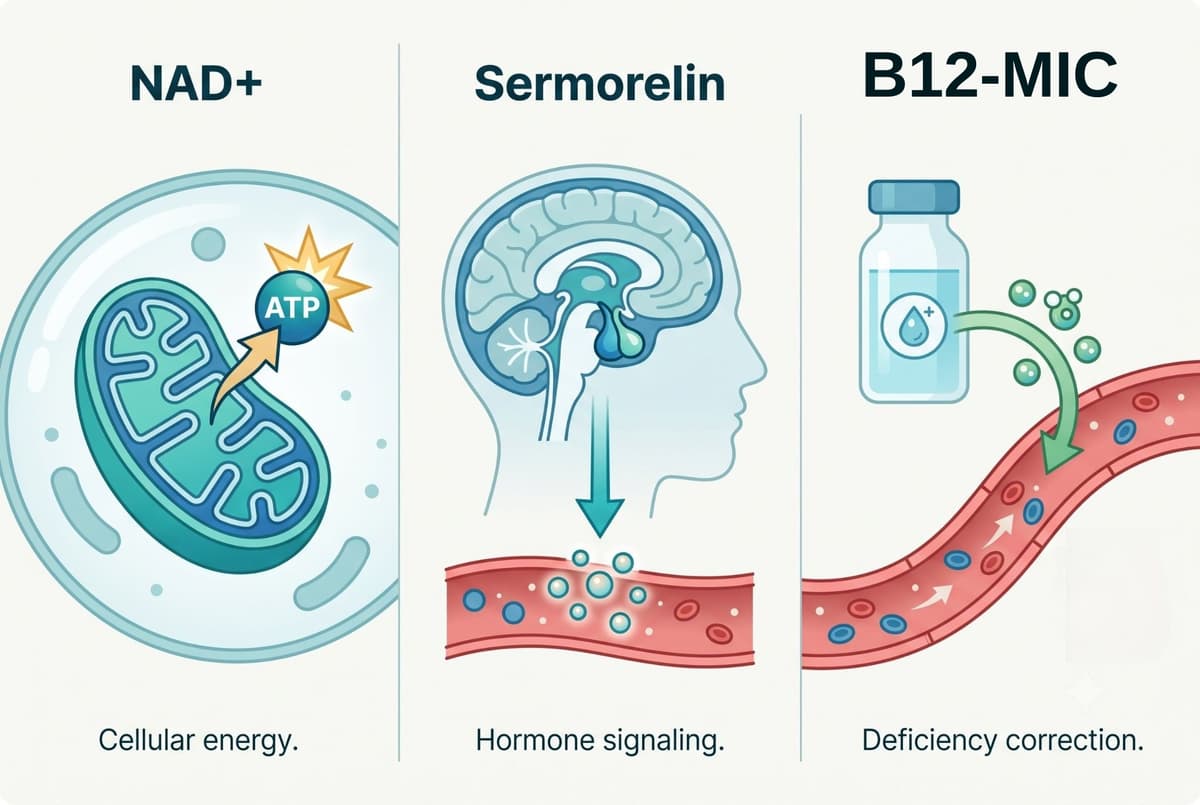
Here's how NAD+, Sermorelin, and B12-MIC compare, since they're often marketed together but work through completely different mechanisms.
 NAD+: Cellular Energy Support
Nicotinamide adenine dinucleotide (NAD+) is a coenzyme every cell uses for energy production and DNA repair. Levels decline with age.
NAD+ is not FDA-approved for any medical or wellness indication. A 2026 PRISMA-guided systematic review in Ageing Research Reviews found that NAD+ precursors reliably raise blood NAD+ levels, but found no eligible controlled outcome trials evaluating IV or IM NAD+ itself for anti-aging or wellness benefits. Any energy or clarity benefit reported by patients is currently supported by biological plausibility more than by direct clinical trial evidence.
Sermorelin: Growth Hormone Signaling Support
Sermorelin is a growth hormone-releasing hormone (GHRH) analog. Instead of supplying growth hormone directly, it signals the pituitary gland to release more of the body's own supply.
The FDA approved the branded version (Geref) in 1990 and 1997 specifically for diagnosing and treating growth hormone deficiency in children. The manufacturer voluntarily discontinued it in 2008 for commercial reasons, and the FDA later confirmed this was not due to safety or efficacy concerns. Sermorelin used today for adult purposes, like body composition or recovery, is compounded and prescribed off-label; adult outcome data is more limited than its pediatric approval history.
B12-MIC: Methylation and Metabolic Support
B12-MIC combines vitamin B12 (cobalamin) with methionine, inositol, and choline (MIC) - a lipotropic blend involved in methylation and fat metabolism, positioning it closer to a vitamin/lipotropic injection than a hormone-signaling peptide.
Vitamin B12 is FDA-approved for treating diagnosed B12 deficiency, and correcting a real deficiency is where the clearest benefit shows up; think improved energy and reduced fatigue. The MIC component's role in supporting fat metabolism is the basis for its lipotropic framing, but the B12-MIC combination itself hasn't been FDA-evaluated as a general energy or weight-management treatment.
What Peptide Therapy Is Not
Peptide therapy is not a universal solution. It does not replace primary care; it does not cure disease in most cases, and it cannot compensate for undiagnosed underlying conditions.
What to Ask Before Starting Peptide Therapy
Five specific questions a patient should ask their provider:
- Is this peptide FDA-approved for my specific use?
- What labs will you run before prescribing?
- What outcomes will we measure?
- What's the stopping point if it's not working?
- Is this compounded or branded?
Peptide Protocols vs. One-Size-Fits-All Wellness Shots
Not all peptide access looks the same. The difference usually comes down to what happens before the prescription, not just what's in the syringe.
- Lab-based, not guesswork. A protocol tailored to your actual bloodwork can target a real deficiency or hormonal pattern, rather than assuming everyone needs the same dose.
- Licensed clinician oversight. A provider reviewing your labs and health history can flag when a peptide isn't appropriate for you.
- Transparent evidence status. You should be told, in plain language, whether what you're taking is FDA-approved for your specific use or being prescribed off-label.
A generic wellness-shot menu, without labs or individualized review, skips most of that. It's worth asking any provider directly what their intake process actually includes before starting.
Who Might Consider Peptide Therapy?
A conversation with a licensed provider is the right next step if you notice:
- Persistent low energy that hasn't improved with sleep or diet changes
- Symptoms consistent with a hormone imbalance, confirmed by labs
- A documented nutrient deficiency, like low B12
- Interest in a physician-guided protocol rather than a self-directed one
Who Should Be Cautious
Peptide therapy isn't appropriate for everyone. Pregnancy, active cancer, certain pituitary conditions, and some medication interactions are reasons a provider may advise against it. This is exactly why lab review and a licensed clinician matter before starting.
Check If Peptide Therapy Fits Your Goals
If you're considering peptide therapy, a licensed provider evaluation is the right starting point - not a self-directed wellness shot menu. Prometheuz offers lab-based assessments that identify whether NAD+, Sermorelin, B12-MIC, or another protocol actually fits your health profile.
Frequently Asked Questions
Is peptide therapy the same as steroids?
No. Steroids directly replace or add a hormone. Many peptides instead signal the body to produce more of its own hormone or support a specific cellular process.
Are peptides safe?
Safety depends on the specific peptide, the dose, and where it's sourced. FDA-approved peptides have extensive safety data for their approved use. Off-label and research-only peptides carry more uncertainty, and sourcing from a licensed provider matters.
How is peptide therapy given?
Most peptide therapies are administered via subcutaneous or intramuscular injection, though some newer formulations are delivered via nasal spray or orally.
Will insurance cover peptide therapy?
Usually not, if the use is off-label or the peptide isn't FDA-approved. FDA-approved uses, like B12 for diagnosed deficiency, are more likely to have coverage pathways.
How long before I'd notice a difference?
This varies by peptide and by what's being treated. Deficiency correction, like low B12, often shows improvement within weeks. Effects tied to broader wellness goals are less predictable and less well studied.
Can I combine NAD+, Sermorelin, and B12-MIC?
Combining peptides should only happen under clinician guidance, since interactions and appropriateness depend on your labs, health history, and goals.
Disclaimer
This content is for educational purposes only and does not replace medical advice. Peptide therapy decisions should be guided by a licensed healthcare provider. Some peptides discussed are not FDA-approved for the uses described and are provided, where applicable, for educational and comparison purposes only.
References
Gallagher C, Emmanuel OO. NAD+ supplementation for anti-aging and wellness: a PRISMA-guided systematic review of preclinical and clinical evidence. Ageing Res Rev. 2026;116:103057. https://www.sciencedirect.com/science/article/pii/S1568163726000498
U.S. Food and Drug Administration. Determination that GEREF (Sermorelin Acetate) Injection was not withdrawn from sale for reasons of safety or effectiveness. Federal Register. 2013. https://www.federalregister.gov/documents/2013/03/04/2013-04827/determination-that-geref-sermorelin-acetate-injection-05-milligrams-basevial-and-10-milligrams
National Institutes of Health, Office of Dietary Supplements. Vitamin B12 Fact Sheet for Health Professionals. https://ods.od.nih.gov/factsheets/VitaminB12-HealthProfessional/