A hormone test result is a number that shows how much of a chemical messenger is in your blood. How to read hormone test results starts with this fact: one number alone does not tell the full story. You need to know your age, the time of day, and your phase of the menstrual cycle.
This blog explains how to read hormone test results step by step, what low or high numbers of your key hormones mean.
Disclaimer: This blog is for educational purposes only, and it does not constitute any professional medical advice. Hormone levels vary by lab, time of day, and person. So, you should always consult your doctor or a specialist before starting any treatment based on your hormone test results. Do not change your medication based solely on what you read here.
What Is A Hormone Test Result?
According to MedinePlus, hormone test results show the level of chemical messengers in your blood. These messengers control your mood, energy, and growth. They act as a scoreboard for your body's proper functioning. A hormone blood test can spot hormonal imbalances before you feel sick.
However, reading hormone results is not an easy task; it requires an understanding of key values. The following sections help you read your hormone test results easily.
How To Read Hormone Test Results: Step-by-Step Easy Guide
Reading your hormone test results is easy if you follow five simple steps. According to clinical investigations from Springer, interpretation requires checking the time and the unit of measure. Do not just look at the high or low arrows. You need the full story.
Step 1: Identify the Hormone Tested:
The first thing you need to follow is to identify the name of the hormone you are going to test. Are you testing estrogen, progesterone, testosterone, or cortisol? It might be Luteinizing Hormone (LH) or Follicle Stimulating Hormone FSH. Doctors may also check thyroid stimulating hormone (TSH) and thyroid hormones (T3, T4).
Each sex hormone lives in a different part of the body. It is mandatory to understand the hormone you are testing.
Step 2: Check the Reference Range:
The second thing is to check the reference range in your report. This range changes by age and gender. A normal level for a man is not the same as for a woman. Clinical studies also show that levels vary based on the lab that ran the test.
Step 3: Compare your Value:
The third thing is to look at the numbers in your report. Whether the numbers are low, high, or fall in the middle range. If your result is inside the range, it is usually normal. If it is outside, it may signal an issue.
Step 4: Consider Timing Factor:
The fourth thing is to consider the timing factor. For women, the phase of the menstrual cycle changes the values of hormones dramatically. Testing follicle stimulating hormone (FSH) on day 3 is different from day 21. For men, testosterone is highest in the morning due to sleep-wake cycles.
Step 5: Look at Hormone Ratio:
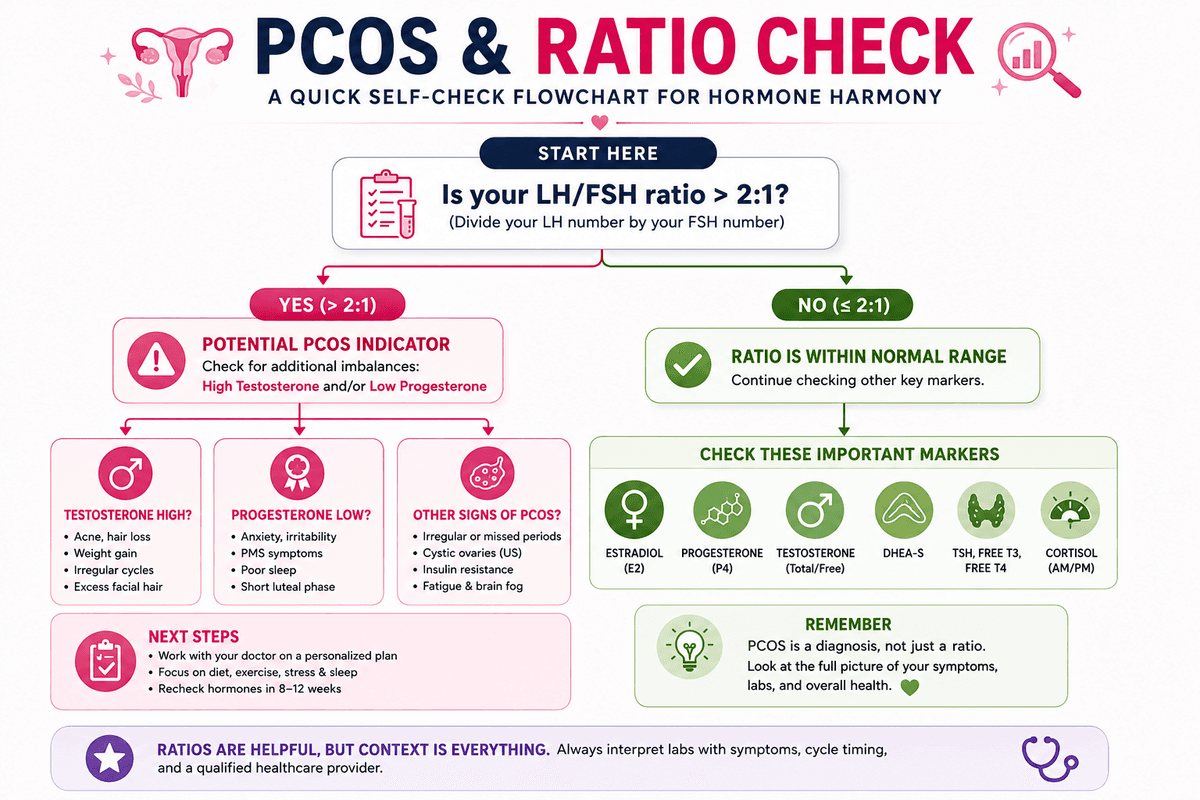
Sometimes the single number looks fine, but the relationship between two numbers seems to be an issue. For example, the LH/FSH ratio is a key flag for PCOS (Polycystic Ovary Syndrome). A ratio higher than 2:1 may indicate a problem, even if both numbers are normal alone.
Normal Hormone Level Chart (Male and Female)
Research investigations provide specific numbers for healthy people. Use this table as your standard sheet. Remember, these values are medians (the middle point). Your unique body may sit a little higher or lower.
| Hormone | Adult Male (Normal) | Adult Female- Follicular phase (Early Cycle) | Adult Female- Luteal Phase (Late Cycle) |
| FSH (mIU/mL) | 1.2 (0.19–8.3) | 3.5 (0.5–13.3) | Varies |
| LH (mIU/mL) | 0.45 (0.23–4.04) | 0.45 (0.24–14.33) | Varies (Peaks mid-cycle) |
| Estradiol (pg/mL) | 12.0 (3.2–40.5) | 13.0 (3.2–96.0) | Higher |
| Progesterone (ng/mL) | 0.3 (0.1–3.2) | 0.3 (0.1–3.7) | > 3.0 (High) |
Note: These numbers come from healthy adults. Always ask your doctor about your specific test results.
Explanation of the Table:
- Early cycle means the first half of the month. It starts on day 1 of your period, and lasts until you release an egg (ovulation).
- Late cycle means the second half of the month. It starts right after you release an egg, and lasts until your next period begins. This is usually days 15 to 28.
- The numbers in the brackets (like 0.19–8.3) are the typical low-to-high range. A result inside this range is usually normal.
How to Interpret Key Hormones: What high and low means
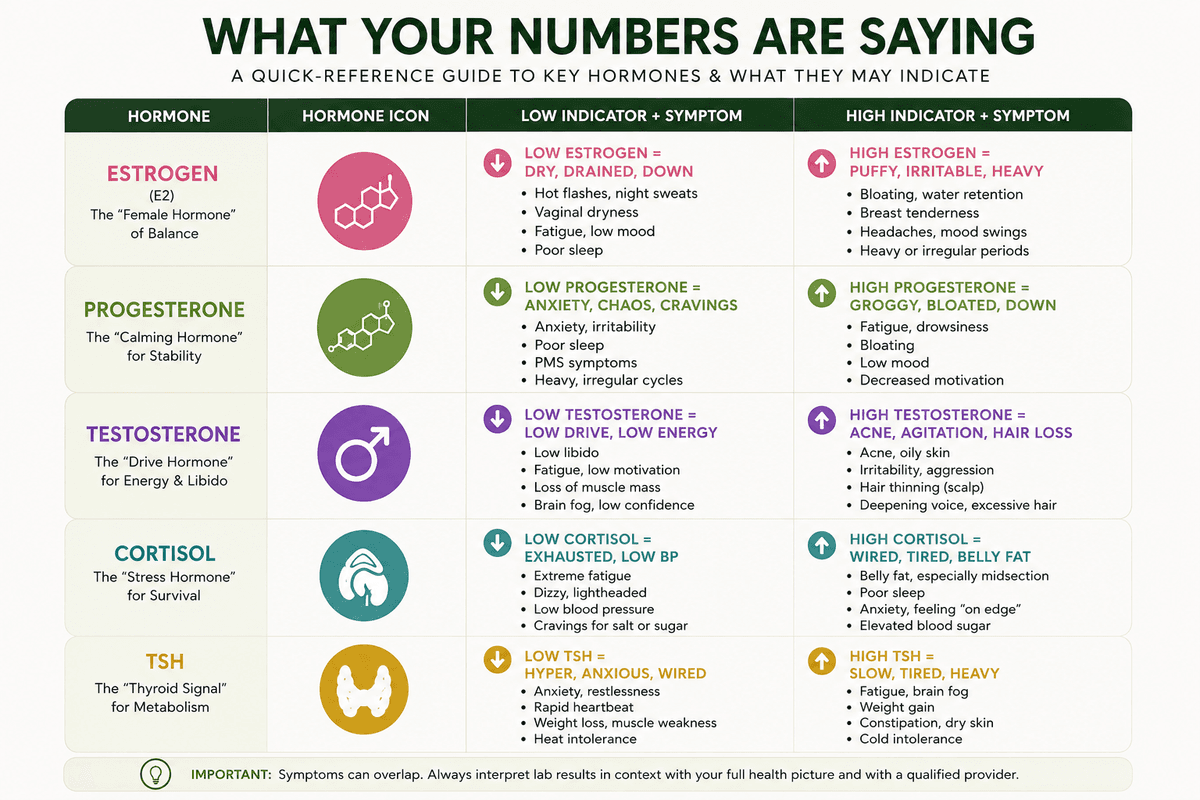
This section explains what the numbers actually do to your body. We look at estrogen, progesterone, testosterone, cortisol, LH, FSH, and TSH.
Estrogen:
- High Estrogen: You may feel bloated or moody, and it may cause heavy periods. Clinical investigations suggest high levels are linked to estrogen dominance.
- Low Estrogen: In low estrogen levels, you might feel dry skin or hot flashes, and this might happen near menopause. Low female hormone levels may also affect bone strength.
Progesterone
- Low Progesterone: This is common in PCOS (Polycystic Ovary Syndrome). It may cause anxiety or spotting before your period.
- Normal Progesterone: It calms your body, and balances the growth effects of estrogen.
Testosterone (male and female interpretation)
- Low Testosterone (Male): You may feel tired, and your sex drive (libido) might drop. Clinical guidelines define this as below 300 ng/dL.
- High Testosterone (Female): Due to high testosterone, you may see acne or facial hair. This often points to PCOS (Polycystic Ovary Syndrome).
Cortisol
- High Cortisol: This is the stress hormone. Too much cortisol may cause weight gain in the belly, and disrupts sleep wake cycles. Research investigations suggest that chronic stress keeps cortisol high.
- Low Cortisol: You might feel very weak or dizzy.
LH and FSH
- High FSH: For women, this suggests the ovaries and adrenal glands are less active. It often means menopause is near.
- High LH: If LH is higher than FSH, doctors suspect PCOS.
TSH, T3, and T4
- High TSH: This usually means low thyroid (hypothyroid). You may feel cold and tired.
- Low TSH: This suggests a high thyroid (hyperthyroid). You may feel shaky or hot.
Important Note: Doctors may prescribe thyroid peroxidase antibody tests to see if your immune system is attacking your thyroid.
How to Read Female Hormone Test Results
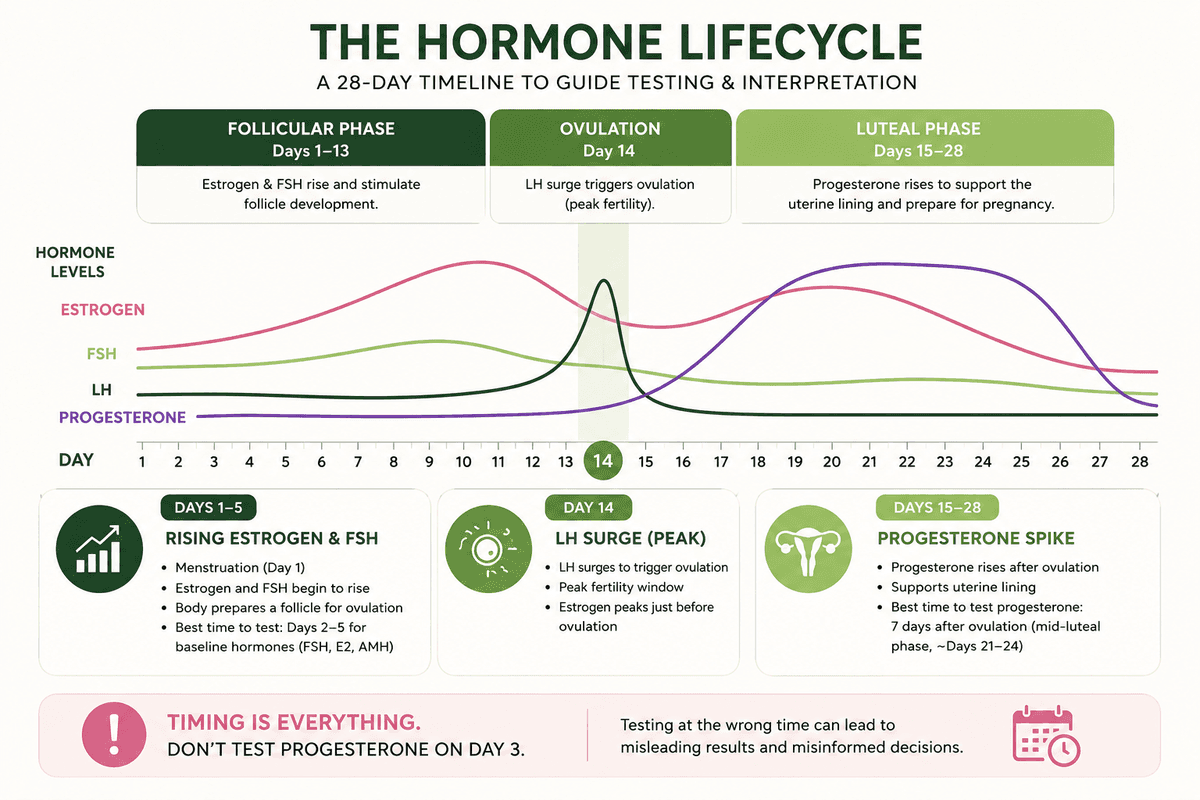
Reading results for women is tricky because of the cycle. Research studies show that doctors must know the phase of the menstrual cycle to read the report right. The following points must be kept in mind while reading female hormone test results.
- Follicular Phase (Days 1-14): In follicular phase, estrogen rises and Follicle Stimulating Hormone (FSH) starts high then drops. Whereas, LH stays low until the surge. A hormone blood test here checks egg health.
- Luteal Phase (Days 15-28): In luteal phase, progesterone plays the main role. High progesterone proves you ovulated. Clinical studies use Day 21 progesterone to confirm ovulation.
- Menopause Considerations: After menopause, estrogen drops very low. FSH and LH go very high (often over 40 mIU/mL).
- PCOS Pattern: PCOS stands for Polycystic Ovary Syndrome, which is a hormone imbalance problem. In PCOS, luteinizing hormone LH is more than double Follicle Stimulating Hormone FSH (a ratio above 2:1). Testosterone is often high too. Because the ovaries do not release an egg, and the body makes very little progesterone. That is why progesterone stays low, especially in the late cycle.
How to Read Male Hormone Test Results
Male testing is more stable, as there is no monthly cycle. However, timing still matters. This research article helps with reading male hormone test results. Keep the following things in mind before reading male hormone test results:
- Total vs Free Testosterone: Total is the whole amount of your testosterone. Free testosterone is what your body actually uses. You need both numbers to know your testosterone levels.
- SHBG Importance: SHBG (Sex Hormone Binding Globulin) holds onto testosterone. If SHBG is high, your free testosterone might be low even if the total looks fine.
- TRT related markers: If you are on therapy, your LH and FSH will drop to near zero. This is normal because the body stops asking the pituitary gland to make more.
Common Hormone Imbalance and What They Mean
Hormonal imbalances happen when your body makes too much or too little of a chemical messenger. These hormone levels can affect your sex drive, mood, and energy in both men and women. Here are the complete details:
High Estrogen
High estrogen refers to when the body has higher levels of estrogen than the normal. Estrogen is a female sexual hormone that controls reproductive health in women. According to MedlinePlus, when its levels are high, women may have heavy periods and mood swings. For men, higher estrogen levels breast growth and erectile dysfunction issues.
Low Progesterone
Progesterone is also a female hormone. When its levels are lower than the normal, women may face a fluctuated timeline of periods (menstruation) and ovulation (formation of eggs). Moreover, women may feel anxious and their periods may begin days before the actual days.
Low Testosterone
Low testosterone can drain your sex drive and leave you feeling tired. A research study states that doctors call it low T when a man's total testosterone drops below 300 ng/dL. What signs should you look for? You may feel worn out all the time. Your muscles might get smaller or weaker. And your desire for sex may drop quite a bit.
High Cortisol
High cortisol is the stress hormone. A research article on cortisol physiology explains that cortisol comes from the adrenal glands. High cortisol may cause weight gain in the face and belly, high blood pressure, and easy bruising.
What are the Factors That Affect Hormone Test Results?
Medications:
Pills can change your hormone levels quickly. A research study shows that oral contraceptives lower AMH (a fertility hormone) within 3 months. Metformin (a diabetes drug) also lowers AMH in women with PCOS. Even vitamin D pills may raise your levels. Always tell your doctor about every pill you take.
Stress:
Stress directly raises cortisol. A research article explains that the HPA axis (a control system in your brain) releases cortisol when you feel pressure. High cortisol may lower your testosterone and thyroid hormones. Being nervous before a needle stick may also spike your levels.
Sleep
Bad sleep wake cycles crush your testosterone. A clinical investigation found that sleep loss lowers morning testosterone in young and older men. It also raises late-afternoon cortisol. One bad night may drop your T levels by a lot. Your body needs deep sleep to fix hormonal imbalances.
Diet
What you eat changes your hormones. Research experts suggest that higher body fat is linked to lower free testosterone. Folic acid and vitamin A intake may lower cortisol levels. Extreme diets or low zinc may also cause low testosterone.
Blood vs Saliva vs Urine Hormone Test
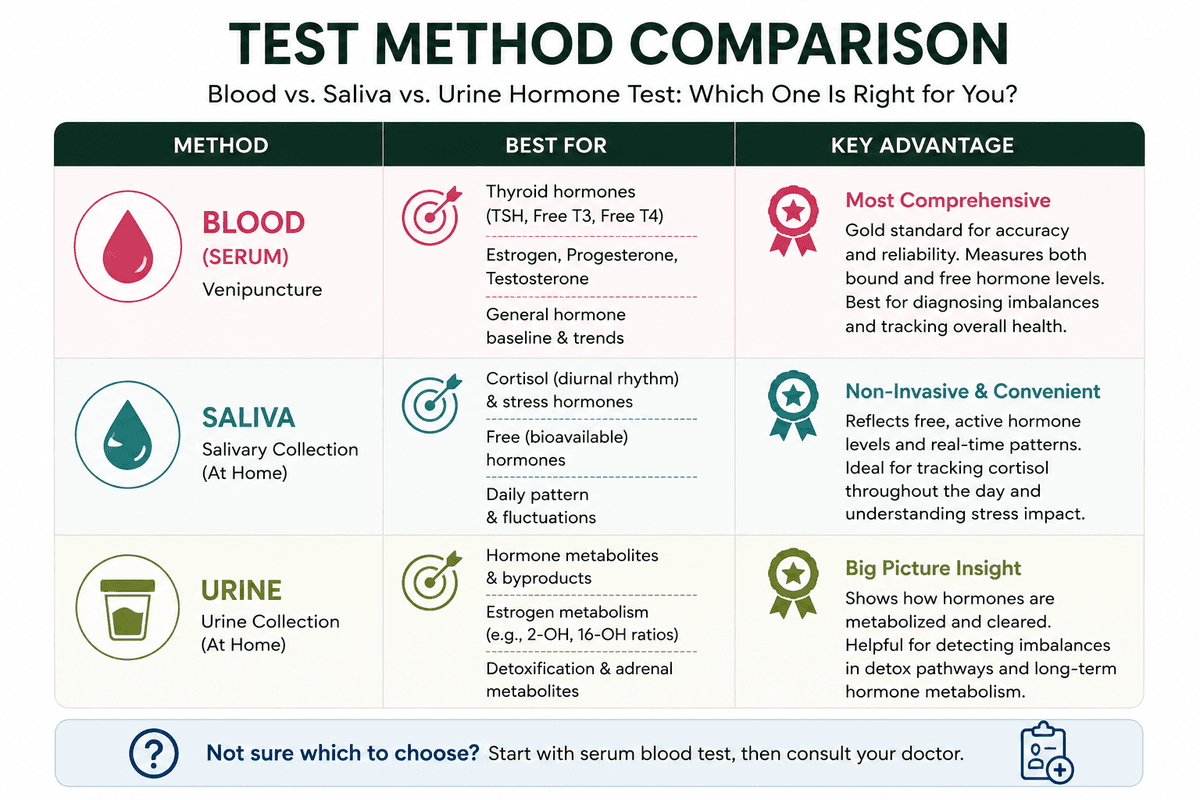
Here is the detailed comparison of blood vs saliva vs urine hormone test provided by a research article published in the National Library of Medicine.
Blood Testing (Serum):
- Pros: It is very accurate, as it measures total hormones.
- Cons: Injection needles can hurt.
- Use: It is best for thyroid, testosterone, and FSH.
Saliva Testing:
- Pros: It measures free (active) hormones and is easy to do at home.
- Cons: It can easily be contaminated by food.
- Use: It is good for cortisol patterns across the day.
Urine Testing:
- Pros: It measures hormones over a full day (metabolites).
- Cons: You cannot tell exactly when your body released each hormone. The test mixes everything together.
- Use: It is best for estrogen metabolism and cortisol cycles
Common Mistakes While Reading Hormone Test Results
According to Frontiers in Endocrinology, even smart people make these errors. Here are the most common mistakes:
- Ignoring the Phase: Checking progesterone during your period. It will always be low. You should check it in the luteal phase.
- Comparing to the Wrong Gender: Using male ranges for a female testosterone test can also lead you to a wrong conclusion.
- Forgetting the Pituitary: If thyroid is low, but TSH is also low, the problem is the pituitary gland (the main gland), not the thyroid itself.
When to See a Doctor
You should see a doctor if you have the following symptoms:
- You feel tired all the time.
- Your sex drive disappears for months.
- Your period stops or becomes very heavy.
- You have unexplained weight gain or loss.
- Your test results show a critical high or critical low flag.
A doctor understands the TRT results timeline if you are on therapy. They know testosterone changes slowly over weeks, not hours.
Frequently Asked Questions
How to read FSH and LH results?
High FSH suggests low egg count in women. An LH higher than FSH suggests PCOS. In men, high LH with low T means the testicles are the issue.
What is the normal range for hormonal levels?
It varies by age. For thyroid stimulating hormone, normal is roughly 0.5 to 4.5 mIU/L. For testosterone, it is 300–1000 ng/dL for men.
Can low estrogen levels raise A1c?
Yes, research investigations suggest that dropping estrogen during menopause may lower insulin sensitivity, which could raise A1c.
Which is more important: LH or FSH?
Neither is more important, but the ratio is key. Luteinizing hormone (LH) triggers ovulation, whereas Follicle stimulating hormone (FSH) grows the egg.
What does it mean if my LH is higher than FSH?
If your LH is higher than FSH (ratio > 2:1), it is a classic sign of PCOS (Polycystic Ovary Syndrome). It is a common hormonal imbalance issue.
Can MTHFR cause hormone imbalance?
Yes, MTHFR can cause hormone imbalance. MTHFR is a gene, and if it does not work well, your body may not remove old estrogen well. This may lead to high estrogen symptoms.
What are the five signs of hormone imbalance?
The five signs of hormone imbalance are constant fatigue, weight gain, low sex drive, hair loss, and mood swings. If you have three of these signs, you are suggested to consult a healthcare professional.
Which hormone is high in females?
Estrogen and progesterone are the two main hormones that are high in females. However, its level depends on the age and health conditions of females.
References:
- https://medlineplus.gov/lab-tests/
- https://link.springer.com/article/10.1186/s40842-019-0086-7
- https://medlineplus.gov/lab-tests/estrogen-levels-test/
- https://medlineplus.gov/lab-tests/testosterone-levels-test/
- https://www.ncbi.nlm.nih.gov/books/NBK538239/
- https://pmc.ncbi.nlm.nih.gov/articles/PMC8042396/
- https://pmc.ncbi.nlm.nih.gov/articles/PMC8042396/
- https://pmc.ncbi.nlm.nih.gov/articles/PMC5460736/
- https://medlineplus.gov/lab-tests/progesterone-test/
- https://www.auajournals.org/doi/10.1016/j.juro.2018.03.115
- https://pmc.ncbi.nlm.nih.gov/articles/PMC9510302/
- https://pmc.ncbi.nlm.nih.gov/articles/PMC12694065/
- https://pmc.ncbi.nlm.nih.gov/articles/PMC12665927/
- https://www.frontiersin.org/journals/endocrinology/articles/10.3389/fendo.2021.727628/full