TRT results follow a staged timeline, not a single moment of change. Some effects begin within a few weeks; others take a year or longer to develop fully, and a few commonly assumed benefits don't hold up as well in trial data as marketing suggests. Starting testosterone replacement therapy (TRT) means committing to a treatment plan and a testosterone therapy timeline, not a single appointment or a medical treatment you complete once and forget.
The Short Version
- What it does: Raises testosterone into the mid-normal range in men with confirmed low testosterone
- Fastest to change: Sexual desire and low libido (weeks), quality of life signals (weeks)
- Slower to change: Erectile function and other sexual dysfunction specifically, mood's full effect (months)
- Slowest to change: Muscle mass, fat mass, bone density improvements (months to a year-plus)
- What often disappoints: Fatigue and general physical function haven't reliably outperformed placebo in the largest trial to test this directly
- Nearly universal: Most men need at least one of several dose adjustments along the way
What TRT Is Actually Trying to Fix for Low Testosterone
Testosterone Replacement Therapy TRT aims to bring testosterone levels into the mid-normal range for young men, commonly a practical target of roughly 400 to 700 ng/dL, in men with confirmed low testosterone tied to an identifiable underlying cause. This treatment doesn't restart your body's own hormone production; it supplies testosterone from outside the body instead. This is a form of hormone replacement therapy, and the goal of the treatment plan is symptom relief and correcting a diagnosed testosterone deficiency, sometimes called male hypogonadism or androgen deficiency, not enhancement beyond a normal physiological range.
Expected outcomes split into two categories: symptom changes (sexual desire, mood, energy levels, mental clarity) and physiological changes (body composition, red blood cell count, bone mineral density). Not everyone experiences the same degree of change. Men starting from very low baseline testosterone levels often notice more, and conditions like obesity, diabetes, or untreated sleep apnea can blunt how much any of this improves.
TRT is FDA-approved only for men with clinically low testosterone tied to an identifiable underlying medical condition, confirmed through evaluation and blood tests, not for chronic low testosterone levels from aging or lifestyle factors alone, even with a confirmed low serum testosterone value. Men with a history of prostate cancer require particular caution and closer monitoring, since testosterone treatment can affect prostate tissue.
The Effects of Testosterone Run on Different Clocks
There's no single answer, because the effects of testosterone emerge on different schedules. A widely cited review in the European Journal of Endocrinology mapped out when specific effects typically begin and when they plateau:
- Sexual interest and sexual desire: appear after about 3 weeks, plateauing around 6 weeks, with no further increase expected beyond that point.
- Erections and ejaculatory function specifically: may take up to 6 months to fully change, slower than general sexual interest, sexual performance, or sexual function overall.
- Quality of life: begins within 3 to 4 weeks, though maximum benefit takes longer.
- Depressive mood symptoms: become detectable at 3 to 6 weeks, but don't reach their full effect until 18 to 30 weeks, roughly 4 to 7 months. This detail matters, since early mood improvement isn't the whole story.
Separately, the largest placebo-controlled trial in this area, the Testosterone Trials (T Trials, 788 men 65 and older), found blood testosterone levels themselves normalized into the mid-normal range by month 3 and held there through 12 months of treatment.
Month by Month: A Rough Map
Weeks 1–3
- Testosterone levels are rising but not yet stable
- Sexual interest may begin to shift
- Most physiological changes haven't started yet
Weeks 3–6
- Sexual interest typically plateaus around this point
- Quality-of-life and mood changes may start becoming noticeable, though mood's full effect is still months away
- Body composition changes aren't visible yet
Month 3
- Blood testosterone levels typically reach the target mid-normal range
- First lab recheck, including hematocrit, usually happens around here
Months 3–6
- Erectile function changes, where they occur, may still be developing (up to 6 months per the research above)
- Mood's fuller effect is developing, since full effect isn't reached until roughly 4 to 7 months
- Early body composition shifts may begin
Months 6–12
- Muscle mass and bone density changes become measurable
- Mood's maximum effect (18–30 weeks) has typically been reached by this window
- First full year of hematocrit and cardiovascular risk monitoring completes
Beyond 12 Months
- Bone density continues developing over a longer horizon
- Ongoing annual monitoring continues as long as treatment continues
This timeline is approximate. Individual response varies, and roughly three-quarters of men need at least one dose adjustment to get here.
The Earliest Signals: Sexual Desire and Quality of Life
Sexual interest and quality-of-life signals are typically the earliest changes, appearing within 3 to 4 weeks per the research above. These are driven by testosterone's relatively fast influence on central pathways tied to sexual desire and general well-being.
Energy is the one people expect to find in this group, and it isn't there. Broad quality-of-life measures did improve early in the research above, but fatigue measured on its own did not outperform placebo in the trial built to test it, which is covered in detail below. Feeling more capable within a month is a common report; treating it as the thing TRT reliably delivers is not what the evidence supports.
Early improvement in one domain doesn't mean everything else has caught up. Feeling a shift in desire at week 4 doesn't mean body composition or bone mineral density have changed yet; those work on a much slower biological timescale.
What's Slower, and What's Weaker Than Advertised
Erectile function specifically can take up to 6 months, notably slower than general sexual interest. In fact, a separate, large, more recent trial (TRAVERSE, 1,161 men with cardiovascular risk factors) found testosterone significantly improved sexual activity and desire but did not significantly improve erectile function at all, a reminder that "TRT helps your sex life" and "TRT fixes erectile dysfunction" are different claims, and the evidence supports the first more consistently than the second. Morning erections, one of the more specific signs of restored androgen levels, may also take time to normalize.
Mood's full effect takes 18 to 30 weeks, several months longer than when it first becomes noticeable.
Body Composition: Fat Mass, Bone Density, and Bone Mineral Density
Muscle mass, fat mass, lean muscle mass, and bone density are the slowest-moving categories, generally requiring months to a year or more. Increased lean muscle mass and reduced fat mass depend partly on whether resistance training and physical activity are part of the picture, since testosterone supports the biological groundwork but training is what converts that into visible change in lean body mass. Bone mineral density improvements follow a similarly slow timeline, typically only becoming measurable after a year or more of consistent treatment.
Mental Clarity and Brain Fog: Where the Evidence Runs Thin
Fatigue and general physical function are the honest exception. The T Trials' dedicated Vitality Trial, which specifically measured fatigue using a validated scale, found no significant improvement compared to placebo. Walking distance in men with mobility limitations wasn't significantly improved as a primary outcome either. A separate T Trials sub-study looking at cognitive function, the kind of mental clarity and reduced brain fog some men hope for, also found no significant improvement over placebo. Some benefit to mood and depressive symptoms has been found separately, but if fatigue, brain fog, or mental clarity specifically are your main goal, the trial evidence doesn't support a reliable fix.
Metabolic Effects and Glycemic Control: Who Actually Benefits
Some competitor content presents improved blood sugar control and metabolic health as a universal, fast-appearing TRT effect. The real picture is more specific than that.
In men with type 2 diabetes and confirmed low testosterone, a large real-world audit across multiple countries found HbA1c (a 2-to-3-month average of blood sugar, a key marker of glycemic control) declined from 8.7% at baseline to 8.2% at 3 months, with continued improvement through 12 and 24 months. A separate meta-analysis of 18 randomized trials in men with diabetes or metabolic syndrome found TRT reduced HbA1c and improved insulin resistance and insulin sensitivity overall, though that same analysis noted the benefit wasn't consistently seen in shorter trials (6 to 12 months), suggesting this is a slower-building effect, not a quick one.
Here's the nuance worth knowing: this benefit appears concentrated in men who already have diabetes or metabolic syndrome. A separate randomized trial in older men with low-normal testosterone but no diabetes, followed for 36 months, found no significant improvement in insulin sensitivity. If you don't have diabetes or metabolic syndrome, don't expect TRT to meaningfully move your blood sugar markers; that's not what the evidence supports for that population.
Does Delivery Method Change the Timeline?
Delivery method doesn't change how fast your body starts using exogenous testosterone- the testosterone supplied by treatment rather than produced naturally- so much as it changes the shape of your levels day to day, and that shape affects how symptoms feel along the way.
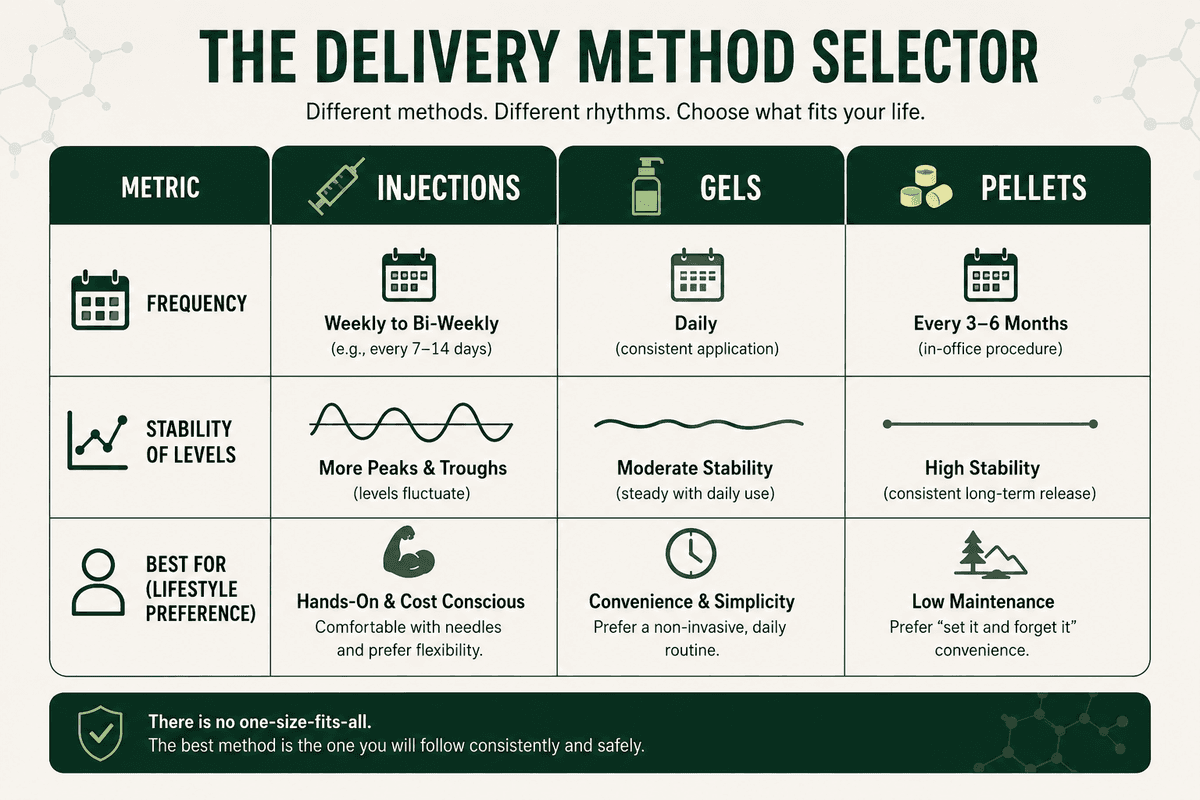
- Testosterone injections (testosterone cypionate, enanthate, or parenteral testosterone undecanoate) peak in your blood 24 to 48 hours after the shot, then decline over the following 1 to 2 weeks before the next dose, a peak-and-trough pattern. Some men notice their energy or mood tracking that curve, feeling better right after a dose and flatter near the end of the cycle. Twice-weekly dosing instead of once-weekly is a common way to smooth this out. Testosterone undecanoate, in particular, is dosed less frequently than cypionate or enanthate.
- Testosterone gel is absorbed daily and reaches a steady state within 24 to 48 hours of starting, producing a more consistent, diurnal pattern closer to how your body naturally produces testosterone, at the cost of daily application and a real risk of transferring the medication to others through skin contact.
- Pellets provide the flattest, most stable levels of any method, with no daily or weekly dosing, but the dose is fixed for the 3 to 6 months until the next insertion. If your level comes back too high or too low, there's no way to adjust until then, or until the pellets are removed.
None of this changes the underlying biological timeline (sexual interest by 3 to 6 weeks, mood's full effect by 18 to 30 weeks, and so on). It changes how stable your day-to-day experience feels while you're getting there.
Why Your Timeline Might Not Match Someone Else's
Baseline testosterone levels. Men starting well below the normal range tend to notice more change than those closer to the lower edge of normal.
Age and overall health. Obesity, diabetes, chronic inflammation, and sleep disorders can all blunt or delay results.
Treatment consistency. Missed doses or inconsistent application delay the whole timeline, since the effects depend on sustained levels, not sporadic ones.
Individual biology. Androgen receptor sensitivity, sex hormone-binding globulin (SHBG) levels, and metabolic rate all vary, so two men on the same dose with the same starting hormone levels can respond differently.
Lifestyle factors. Resistance training measurably improves how much lean mass change shows up. Poor sleep quality can blunt results and physical performance even when blood levels are in range. A balanced diet and regular physical activity support the changes TRT is trying to produce, while excess body fat increases conversion of testosterone to estrogen, which can work against the treatment. Psychological factors, including stress and mood, can also shape how much of a difference the treatment feels like it's making, separate from what the labs show.
What Your Clinician Is Actually Tracking, Including Blood Pressure
Monitoring isn't just a safety requirement; it's how you and your clinician tell the difference between a slow-but-normal response and something that actually needs adjusting.
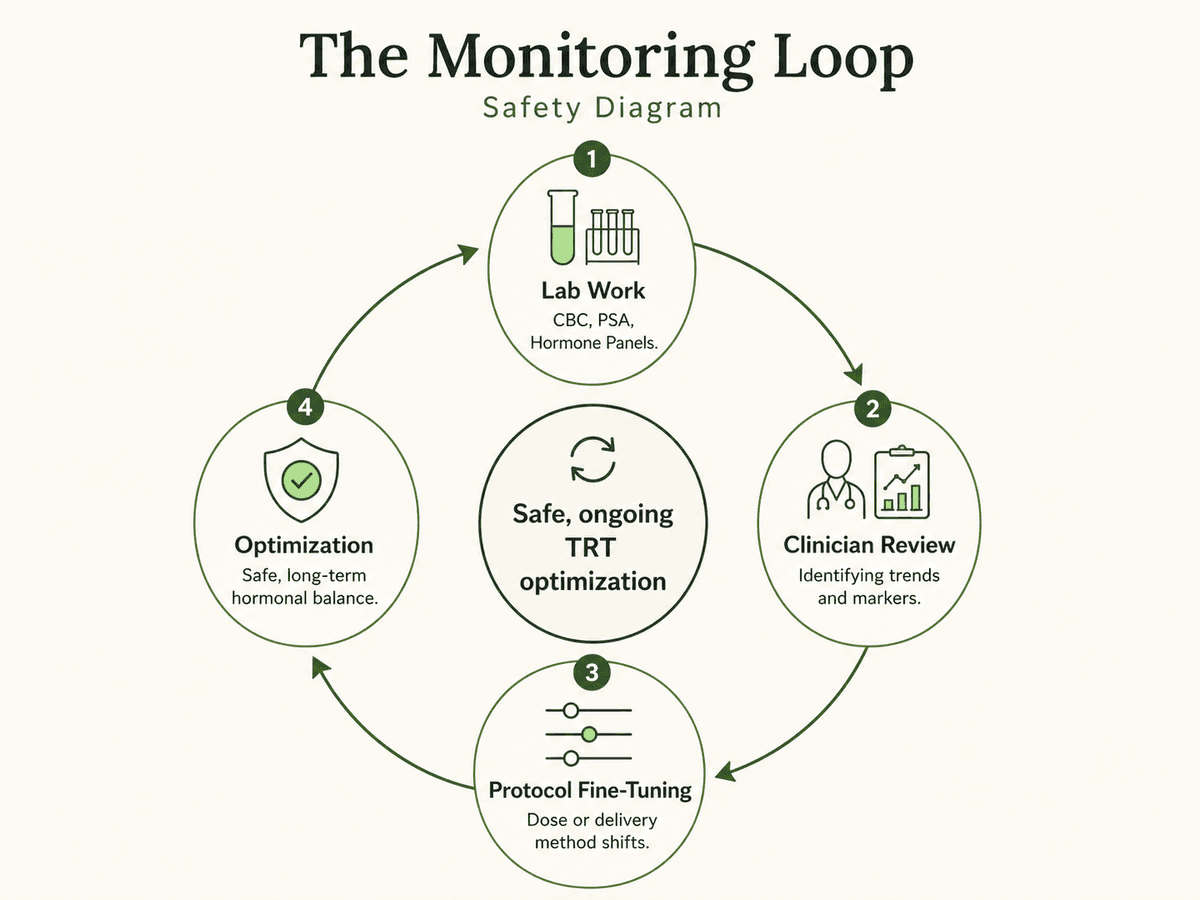
- Baseline, before starting: testosterone, hematocrit, blood pressure, and prostate-specific antigen (PSA) where age-appropriate.
- 3 to 6 months in: testosterone recheck to confirm target range and adjust dose, plus hematocrit and blood pressure.
- 12 months: repeat labs, including hematocrit and PSA.
- Annually after that, if stable.
Hematocrit gets particular attention because the risk of it rising too high, called erythrocytosis, is concentrated in the first year of treatment. U.S. guidelines generally use a threshold of 50%; European guidelines use 54%. One study specifically identified hematocrit at or above 52% during the first year as an independent risk factor for cardiovascular and clotting events, part of why this lab doesn't wait until the annual visit.
Two people can have identical testosterone levels on paper and report very different experiences, which is why tracking symptoms (energy, sleep, mood, libido) alongside labs gives your clinician the fuller picture.
Three Phases, In Plain Terms
Initiation (Weeks 1–6). Your body is responding to the new testosterone supply, and your own natural production is winding down as the hypothalamic-pituitary-gonadal axis adjusts. Early changes may appear, but levels aren't stable yet.
Adjustment and Stabilization (Months 2–6). This is where the dose gets fine-tuned based on labs and symptoms. In the largest trial in this area, 76% of men needed at least one dose adjustment during this kind of window to land in the target range; this is the norm, not a sign of a problem.
Maintenance (Months 6+). Once levels and dose are settled, monitoring continues on a regular but less frequent schedule. Longer-term changes in bone density and body composition continue developing during this phase.
If It's Not Working the Way You Expected
- Dose too low. The most straightforward, and most fixable, cause of limited results, usually caught at a follow-up lab.
- Underlying conditions. Obesity, untreated sleep apnea, depression, and thyroid disorders can all mute or mimic the symptoms TRT is meant to address.
- Inconsistent use. Missed injections or irregular topical application disrupts the steady levels the treatment depends on.
- Unrealistic expectations. TRT restores a normal range; it doesn't produce above-normal effects. Its impact on muscle mass specifically is modest without resistance training alongside it. Setting realistic expectations from the start avoids a lot of frustration later.
- Elevated SHBG. Sex hormone-binding globulin can bind up testosterone so it's not biologically active, meaning a "normal" total testosterone number can still come with real symptoms if free testosterone is low. A free testosterone test can clarify this.
If results seem limited after 3 to 6 months of confirmed therapeutic testosterone levels, that's the point for a clinical reassessment, not more waiting.
Frequently Asked Questions
How quickly will I notice a difference after starting TRT?
Sexual interest and general well-being are the earliest changes, often within 3 to 4 weeks. Full effects on mood take considerably longer, 18 to 30 weeks, and physical changes like muscle or bone density take even longer than that.
What does TRT feel like in the first week?
Most people notice little to nothing in the first week. Testosterone levels are still rising, not yet stabilized. This is normal, not a sign the treatment isn't working.
Will TRT fix my fatigue?
Not necessarily. A large placebo-controlled trial specifically measuring fatigue found no significant improvement with testosterone compared to placebo. Some benefit to mood has been found separately, but fatigue itself is a weaker, less reliable target than commonly assumed.
Will TRT fix erectile dysfunction specifically?
It can help, but the evidence is mixed and generally weaker than for sexual desire. One large recent trial found no significant improvement in erectile function despite improving desire and activity. Erectile changes, where they occur, can also take up to 6 months, longer than other sexual effects.
Why did my clinician change my dose?
This is common, not a problem. In the largest trial in this area, more than three-quarters of men needed at least one dose adjustment over a year to land in target range.
How long does it take to see changes in muscle mass?
Muscle and bone changes are the slowest-moving outcomes, typically requiring months to a year or more, and depend partly on whether you're doing resistance training alongside treatment.
Do TRT results stop if you go off treatment?
Testosterone levels generally decline back toward pre-treatment levels after stopping, and symptoms of low testosterone may return. Talk to your clinician before stopping, since abrupt discontinuation can temporarily suppress your body's natural production further.
Get a Clear, Realistic Picture Before You Start
A full evaluation and honest expectations, not marketing promises.
Related Reading
- Testosterone Replacement Therapy (TRT)
- Does Stress Lower Testosterone? The Answer Depends on What Kind
- Does Testosterone Help You Sleep Better? The Science Explained
Disclaimer
This content is for educational purposes only and does not replace medical advice. It reflects the research available as of publication and may be updated as new evidence emerges. Testosterone therapy and hormone-related decisions should be guided by a licensed healthcare provider.
References
Saad F, Aversa A, Isidori AM, Zafalon L, Zitzmann M, Gooren L. Onset of effects of testosterone treatment and time span until maximum effects are achieved. Eur J Endocrinol. 2011;165(5):675-685. https://academic.oup.com/ejendo/article/165/5/675/6677022
Bhasin S, Brito JP, Cunningham GR, et al. Testosterone Therapy in Men With Hypogonadism: An Endocrine Society Clinical Practice Guideline. J Clin Endocrinol Metab. 2018;103(5):1715-1744. https://pubmed.ncbi.nlm.nih.gov/29562364/
Snyder PJ, Bhasin S, Cunningham GR, et al. Effects of Testosterone Treatment in Older Men. N Engl J Med. 2016;374(7):611-624. https://www.nejm.org/doi/full/10.1056/NEJMoa1506119
Cunningham GR, Stephens-Shields AJ, Rosen RC, et al. Testosterone Treatment and Sexual Function in Older Men With Low Testosterone Levels. J Clin Endocrinol Metab. 2016;101(8):3096-3104. https://pubmed.ncbi.nlm.nih.gov/27355400/
Pencina KM, Travison TG, Cunningham GR, et al. Effect of Testosterone Replacement Therapy on Sexual Function and Hypogonadal Symptoms in Men with Hypogonadism. J Clin Endocrinol Metab. 2024. https://pubmed.ncbi.nlm.nih.gov/37589949/
Ory J, et al. Secondary Polycythemia in Men Receiving Testosterone Therapy Increases Risk of Major Adverse Cardiovascular Events and Venous Thromboembolism in the First Year of Therapy. J Urol. https://www.auajournals.org/doi/10.1097/JU.0000000000002437
Diem SJ, et al. Testosterone Replacement in Men with Age-Related Low Testosterone: What Did We Learn From The Testosterone Trials? https://pmc.ncbi.nlm.nih.gov/articles/PMC7009797/
Snyder PJ, Matsumoto AM, Stephens-Shields AJ, et al. Lessons From the Testosterone Trials. Endocr Rev. 2018;39(3):369-386. https://academic.oup.com/edrv/article/39/3/369/4924422
Jones TH, et al. Testosterone replacement improves glycaemic control in men with type 2 diabetes: real-world audit data. Presented at the European Association for the Study of Diabetes Annual Meeting, 2023. https://www.eurekalert.org/news-releases/1003265
Li SY, et al. Metabolic Effects of Testosterone Replacement Therapy in Patients with Type 2 Diabetes Mellitus or Metabolic Syndrome: A Meta-Analysis. Int J Endocrinol. 2020. https://onlinelibrary.wiley.com/doi/10.1155/2020/4732021
Gianatti EJ, et al. Long-Term Testosterone Administration on Insulin Sensitivity in Older Men With Low or Low-Normal Testosterone Levels. J Clin Endocrinol Metab. 2018. https://academic.oup.com/jcem/article/103/4/1678/4822914
Pastuszak AW, et al. Pharmacokinetics of testosterone therapies in relation to diurnal variation of serum testosterone levels as men age. Andrology. 2022. https://onlinelibrary.wiley.com/doi/full/10.1111/andr.13108
U.S. Food and Drug Administration. Testosterone Information. https://www.fda.gov/drugs/postmarket-drug-safety-information-patients-and-providers/testosterone-information