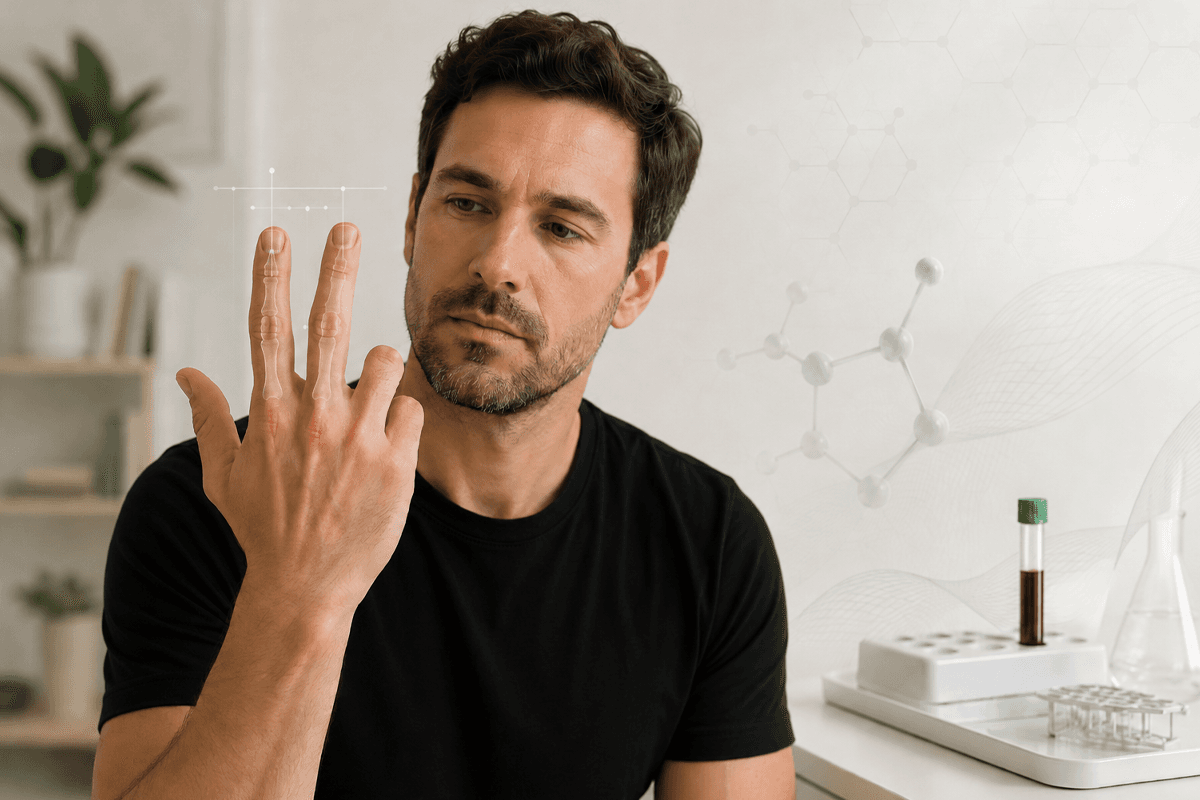
Can you really measure testosterone by comparing finger lengths? No. But the science behind why people believe this is worth understanding. The testosterone finger length test (also called the finger length testosterone test) is a scientific theory that compares the length of the index finger and the length of the ring finger. This is called the 2D:4D length ratio. Some early research published in the Journal of Andrology proposed that this ratio may be influenced by testosterone in the womb during fetal development.
The idea suggests that greater testosterone exposure or higher androgen exposure in the womb may be linked to a longer ring finger compared to the index finger. This is based on observed statistical patterns, not a diagnostic method.
However, later research published explains that while prenatal hormones may influence development, finger length is not a reliable indicator of testosterone levels later in life. Because of this, it remains a research idea, not a clinical test.
What Is the Testosterone Finger Length Test?

The testosterone finger length test, also known as the digit ratio or 2D:4D ratio, is based on comparing the second and fourth fingers the index finger length (second digit) and the ring finger length (fourth digit).
In scientific research, this ratio is described as a sexually dimorphic trait, meaning it tends to show small average sex differences between males and females. On average, males often have slightly lower ratios (lower 2D:4D ratio), where the ring finger is relatively longer than the index finger.
Because of this, the 2D:4D ratio is used in research on development, human behavior, and hormone patterns. However, it is not a medical test. It cannot measure current testosterone levels in an individual.
Causes and Biological Mechanism
Finger length develops early in the womb while bones are forming. At this stage, prenatal sex hormones like testosterone and estrogen levels may affect bone growth. Researchers use this ratio as a possible indirect marker of prenatal testosterone exposure or how much testosterone exposure during fetal development.
The idea behind the 2D:4D ratio is simple. Early hormone levels may slightly affect digit length, specifically the length of the index and ring fingers.
Research suggests hormones may act on growth plates through androgen receptor activity. These growth plates guide bone growth before they harden.
A study in Early Human Development found a statistical link between the 2D:4D ratio and changes in the posterior tibial slope (PTS). This is a bone structure formed through growth plate activity.
This suggests prenatal hormone balance may influence bone development in different parts of the body. However, hormones are not the only factor. Genetics, natural growth variation, and other factors also play a major role.
Because of this, the digit ratio is not a direct measurement of testosterone.
Debunking Common Myths About the Testosterone Finger Length Test

The testosterone finger length test is often used online to claim that finger shape can reveal testosterone, aggression, masculinity, sexuality, or personality. This idea comes from the 2D:4D ratio, which compares the index finger to the ring finger. While some studies found small average group differences, later reviews show these effects are often weak, inconsistent, or not useful for predicting traits in one person.
Myth: Finger Length Can Show Your Testosterone Level
Many people use the testosterone finger length test to guess testosterone levels. The idea is that a longer ring finger means more testosterone or higher testosterone levels, while a longer index finger means lower levels.
A study published in Scientific Reports found no link between digit ratio (2D:4D) and testosterone changes in men during exercise. This suggests finger ratio does not track real-time hormone levels.
Another study in BJU International found a weak link between higher 2D 4D ratio and lower testosterone in older men. However, this was a specific clinical group and does not prove diagnostic value for the general population.
Myth: Finger Length Predicts Aggression
One claim is that a longer ring finger means higher aggression, physical aggression, or dominance. This is linked to prenatal testosterone and brain development.
A meta-analysis in Personality and Individual Differences found no evidence in females and only a very small association in males (about r ≈ -0.06). This is too weak to predict behavior in individuals.
Previous studies including research in Psicothema found no meaningful link between digit ratio and aggression. Overall, finger length does not predict aggression.
Myth: Finger Length Reveals Masculinity or Femininity
Some studies show small average differences in finger ratios. Men generally have slightly lower 2D:4D ratios than feminine digit ratios.
However, research also shows large overlap between men and women. Many individuals do not follow the average pattern.
A meta-analysis on sex-role orientation found very small and inconsistent associations. Some results depended on one large study. This means finger ratio cannot reliably measure masculinity or femininity.
Myth: Finger Length Can Identify Sexual Orientation
Some studies report that lesbian women may have slightly lower digit ratios than straight women. This is linked to prenatal androgen exposure during development. A review in Hormones and Behavior found group-level differences in several studies investigating sexual orientation and digit ratio. However, these apply only to averages.
The key point is simple: group differences cannot be used to identify individuals. Finger ratio cannot determine sexual orientation.
What Science Measures vs What People Assume
Science uses the 2D:4D ratio mainly as a research tool to study early development and possible prenatal hormone exposure. It is used to study groups, not diagnose one person.
Many people search for the testosterone finger length test because they have symptoms like low energy, low libido, poor recovery, or low mood. They may hope finger length can tell them if they have low testosterone. Current scientific evidence does not support that use.
[cta]Finger ratio cannot measure current testosterone levels, confirm low testosterone, or explain symptoms(eg erectile dysfunction, ) . A person with symptoms may have normal testosterone, while someone with low testosterone may have average finger ratios.symptoms (e.g.,
Using finger length instead of proper testing can delay real diagnosis and treatment.
How Testosterone Levels Are Properly Measured
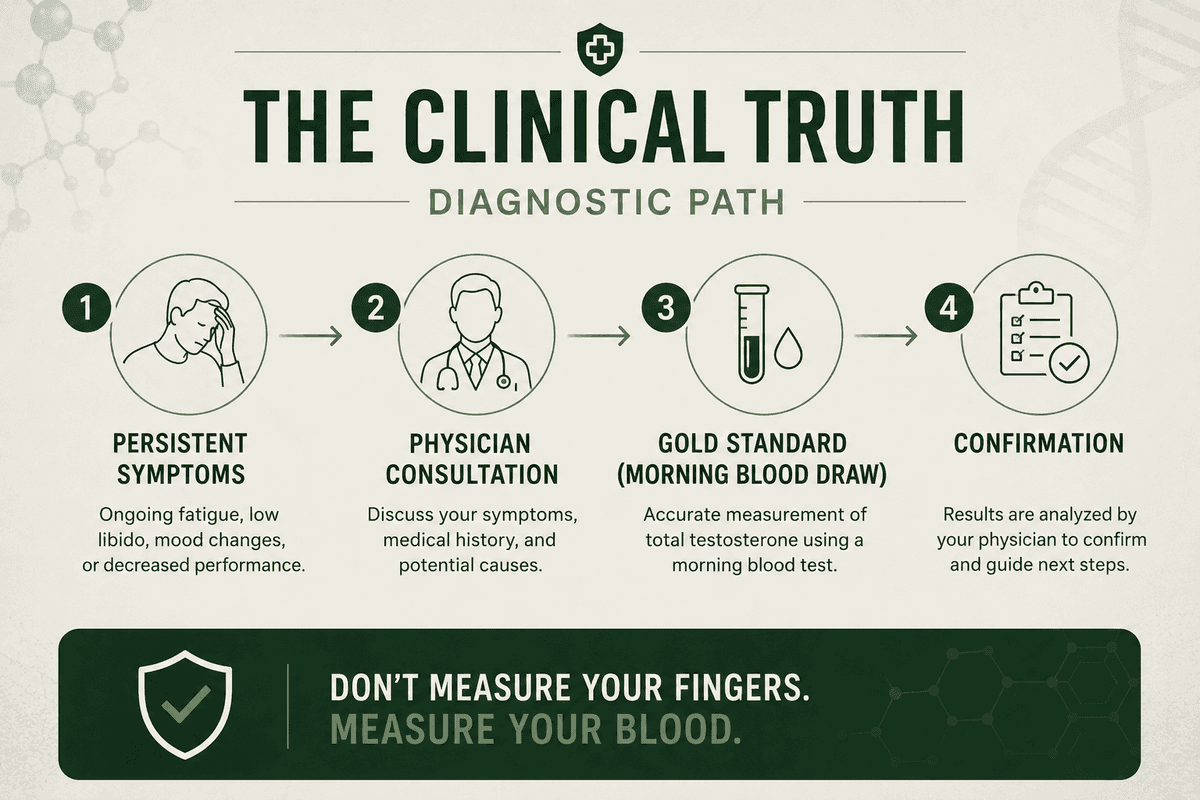
The testosterone finger length test is not used in medicine. It cannot estimate hormone levels. If testosterone levels need to be checked, a medical evaluation is needed.
The standard clinical methods include:
- Morning blood test for total testosterone
- Repeat testing on a separate day for confirmation
- Free testosterone testing (if needed)
- SHBG, LH, and FSH tests to identify hormonal causes
- Medical history review and symptom assessment by a licensed clinician
What the Testosterone Finger Length Test Cannot Be Used For
The testosterone finger length test (2D:4D ratio) is not a medical tool. Research does not support using it for personal assessment.
It cannot be used to:
- Estimate current testosterone levels
- Diagnose low testosterone or other hormones
- Predict human reproduction, sperm production, sex drive, libido, or sexual function
- Identify aggression, behavior, or personality traits
- Classify masculinity, femininity, or identity
- Replace blood testing or clinical evaluation
Most digit ratio research looks at group trends, not individual prediction. Even when small links exist, they are too weak for medical or behavioral use.
If Not Finger Length, How Do You Actually Test for Low Testosterone?
The testosterone finger length test cannot diagnose low testosterone. Proper evaluation requires blood testing and medical assessment.
If you experience persistent fatigue, low libido, difficulty building muscle, brain fog, or mood changes, clinical testing is needed.
Blood Testing for Testosterone
Testosterone is measured through blood tests ordered by a licensed healthcare provider.
Total Testosterone Test
This measures total testosterone in your blood. Testing is done in the morning (7–10 AM) when levels are highest. A result below 300 ng/dL is generally considered low.
Free Testosterone Test
This measures active, unbound testosterone available for use by your body. It is often used when total testosterone results are borderline or symptoms persist despite normal total levels.
Repeat Testing Required
Testosterone levels fluctuate. Clinical guidelines recommend at least two separate morning tests to confirm low testosterone. A single test is not enough for diagnosis.
Remember low testosterone is a clinical diagnosis. It requires both confirmed low lab values and symptoms affecting quality of life.
When Is Testosterone Replacement Therapy Considered?
If testing confirms low testosterone and symptoms are present, a healthcare provider may discuss treatment options. Testosterone replacement therapy (TRT) is one medical treatment for clinically diagnosed hypogonadism.
Who May Be a Candidate for TRT
TRT is not appropriate for everyone. Typical candidates meet these criteria:
- Confirmed low testosterone (below 300 ng/dL on two separate tests)
- Symptoms affecting daily function (low energy, reduced libido, muscle loss)
- No contraindications (active prostate cancer, severe sleep apnea, plans for fertility)
FAQ
Is the testosterone finger length test real?
It is a research idea, not a real medical test.
Can the fourth digit length ratio indicate low testosterone levels?
Short answer, No. It cannot measure current or past testosterone levels.
Why do some people have lower digit ratios with a longer ring finger?
The digit ratio differences may be influenced by early human development and genetics.
Is the digit length (2D:4D ratio) used in hospitals?
No. It is not part of medical testing.
Does science agree on this finger length testosterone test?
No. Research results are mixed and not fully agreed on.
Does luteinizing hormone affect finger length ratio?
No. LH is produced after birth and regulates adult testosterone production. Digit ratio is set during fetal development before LH becomes active.
Can the Test Predict Personality Type?
No. While some studies examined links between digit ratio and personality traits, results are inconsistent and cannot predict personality type in individuals
Conclusion
The testosterone finger length test is not a valid medical tool. Research shows it cannot measure testosterone levels or diagnose low testosterone.
If you are experiencing symptoms like fatigue, low libido, or difficulty building muscle, proper blood testing and medical evaluation are needed. Finger length cannot replace clinical testing.
Understanding your hormone health starts with accurate lab work, not online theories.
Disclaimer
The information provided here is for educational purposes only and does not constitute medical advice. Hormone therapies carry real risks and are not appropriate for everyone. Individual outcomes vary. Always consult a licensed healthcare provider before making any medical decisions.
References
Manning JT, Scutt D, Wilson J, Lewis-Jones DI. The ratio of 2nd to 4th digit length and hormone levels. J Androl. 1998 Mar-Apr;19(2):163-9. PMID: 15620791.
https://pubmed.ncbi.nlm.nih.gov/15620791/
Breedlove SM. Through a glass, darkly: Human digit ratios reflect prenatal androgens, imperfectly. Hormones and Behavior. 2020;120:104686.
https://www.sciencedirect.com/science/article/abs/pii/S0018506X2030012X
Hönekopp J, Watson S. Meta-analysis of digit ratio (2D:4D) and behavior traits. Personality and Individual Differences. 2011;51(4):381-386.
https://doi.org/10.1016/j.paid.2010.05.008
Voracek M, Loibl LM. Digit ratio and behavioral variability: methodological limitations. Personality and Individual Differences. 2009.
https://doi.org/10.1016/j.paid.2009.03.015
Kowal M, et al. No relationship between digit ratio and testosterone response. Scientific Reports. 2020.
https://pubmed.ncbi.nlm.nih.gov/32572079/
Garcia-Cruz E, et al. Digit ratio and testosterone deficiency in clinical population. BJU International. 2011. https://pubmed.ncbi.nlm.nih.gov/21592297/