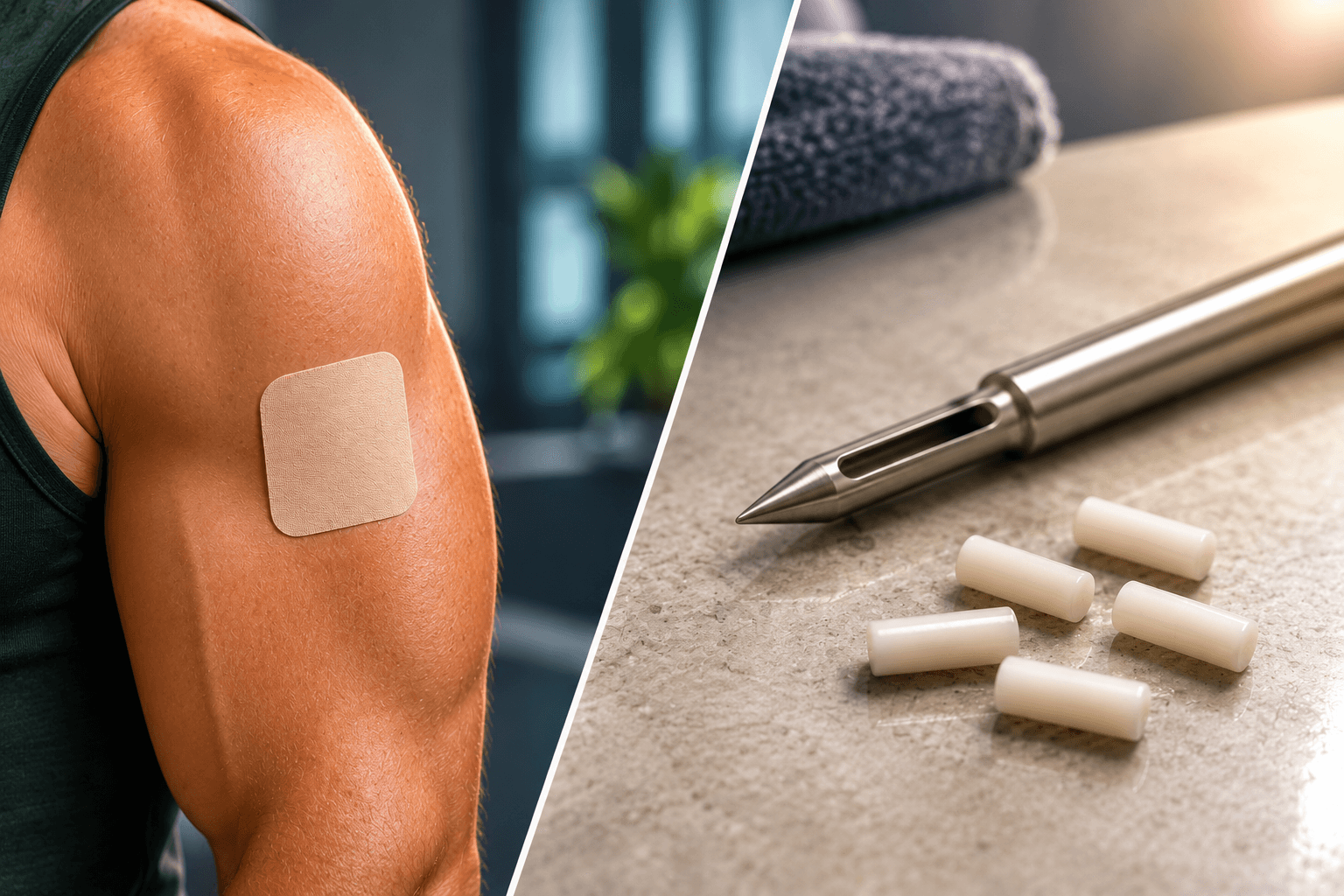

The testosterone patch is barely an option anymore in the US. Androderm, the only FDA-approved transdermal testosterone patch, was discontinued in 2023. That leaves testosterone pellets as the main long-acting alternative to daily gels or weekly injections.
Low energy, fatigue, reduced muscle mass, and low libido are the usual reasons men look into testosterone replacement therapy at all. Exogenous testosterone, meaning testosterone that comes from outside your body rather than your own production, can be delivered several ways. This article breaks down how pellets actually work, what the research says about their risks, and where patches (and their estrogen counterparts, still used in women's hormone replacement therapy) fit into the bigger picture of testosterone therapy today.
How Testosterone Patches Used to Work
Applied Nightly, Dosed in Milligrams, Not Months
Testosterone patches like Androderm delivered a steady 2 to 6 mg of testosterone per day through the skin, usually applied once nightly to the back, abdomen, thighs, or upper arms. Peak levels showed up 6 to 8 hours after application, closely following the body's natural daily testosterone rhythm.
Dosing could be adjusted in days, not months. If labs came back too high or too low, a provider could bump the strength at the very next patch.
The One Real Advantage: It Reversed Fast
Patches had one clear edge over pellets: reversibility. According to PubMed, a pharmacokinetics review in Translational Andrology and Urology found testosterone levels dropped back to baseline within about 24 hours of removing the patch. Pellets offer no such off-switch. Once inserted, you're committed to whatever dose is under your skin until it dissolves months later.
That fast reversal made patches a reasonable option for men who wanted to stop or adjust therapy quickly, such as those managing side effects or planning a pregnancy.
Testosterone Patches Are Almost Impossible to Find in the US Now
Androderm, the Only FDA-Approved Patch, Is Gone
Androderm was the sole FDA-approved testosterone transdermal patch sold in the US. AbbVie, through its subsidiary Allergan, stopped making it in early 2023. No generic version was ever approved, and no other manufacturer has stepped in to fill the gap.
The American Society of Health-System Pharmacists listed the shortage as permanent, not temporary. So if a provider brings up "the patch" as an option, they're likely talking about compounded testosterone creams or gels applied to the skin, not an actual adhesive patch.
Even When Available, Patches Caused Skin Reactions in Nearly Half of Users
Skin irritation was always the patch's biggest weakness. According to PubMed, a pharmacokinetics review in Translational Andrology and Urology found that combined clinical trial data put application-site reactions at roughly 48%. Itching was the most common complaint.
That same review found gel formulations caused far fewer skin problems than patches did. This is part of why gels largely replaced patches even before Androderm disappeared. When Androderm was still on the market, it was applied to dry skin on the lower abdomen, back, or upper arm, with a new patch needed every single day to keep dosing steady in daily life.
You've probably felt an adhesive bandage get itchy after a day. Now imagine wearing one, in the same rotation of spots, every single day for months.
How Testosterone Pellets Actually Work in Hormone Replacement Therapy
A Trocar Places Pellets Under the Skin in a Minor Surgical Procedure
Pellets are small, rice-grain-sized cylinders of crystallized testosterone. A provider numbs the hip area or upper buttock with local anesthetic. Then a hollow needle called a trocar inserts several pellets under the skin through a tiny incision. This minor surgical procedure is done in-office, not in an operating room.
The whole visit typically takes 10 to 15 minutes. No stitches are usually needed. Most men have 6 to 12 pellets placed at once, depending on their dose. Unlike subcutaneous injections, which need to be repeated weekly, pellets sit in place and slowly release hormones into the bloodstream over several months through continuous release.
Pellets Spike High Early, Then Fade Toward the End of the Cycle
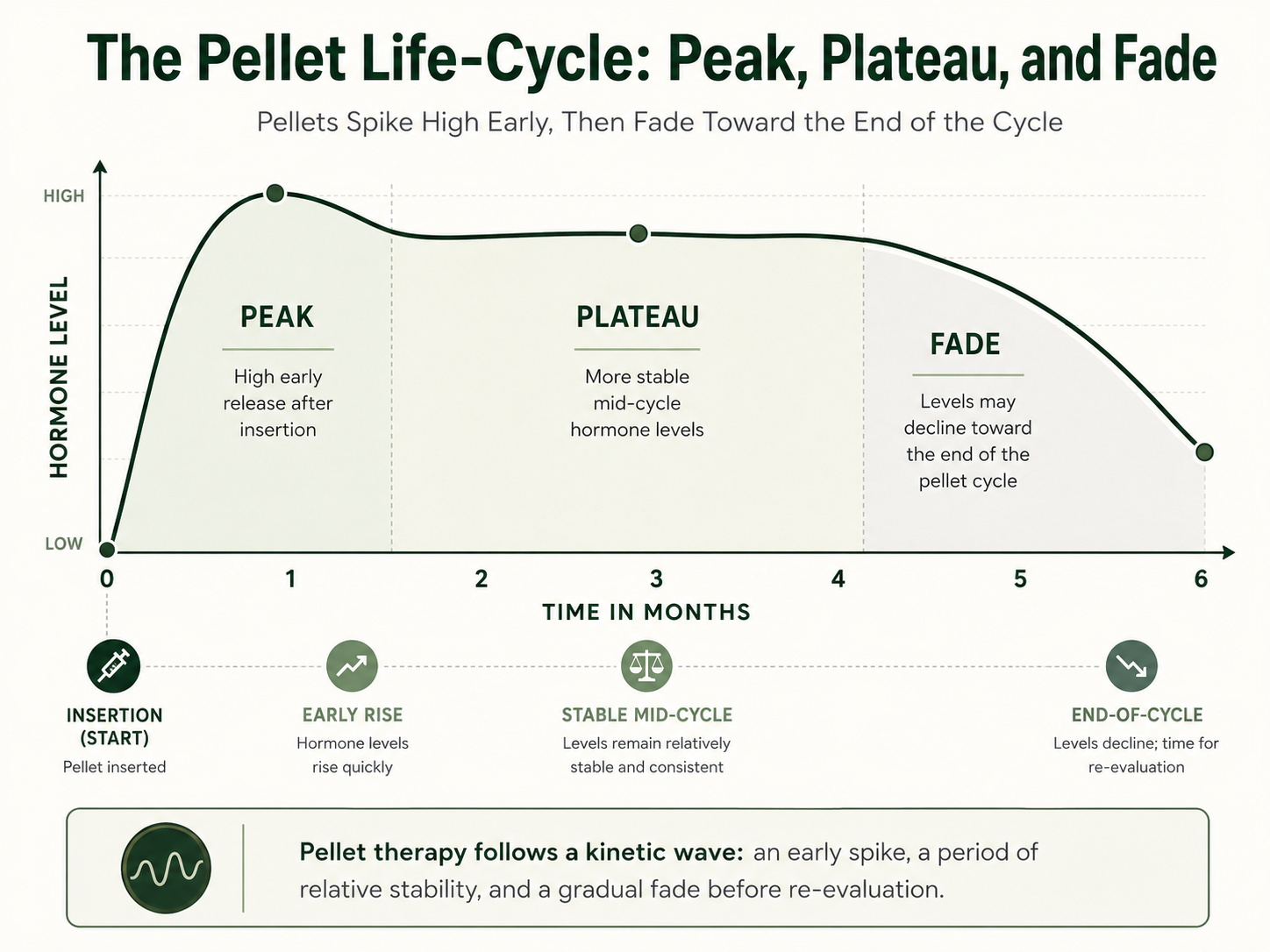
Pellets don't release hormones in a flat, even line. According to PubMed, a randomized trial in Sexual Medicine comparing a branded pellet (Testopel) to a compounded version found testosterone levels were similar between the two. But both climbed fast after insertion and then dropped over time.
In that same trial, 82% of men had fallen below 300 ng/dL, the low end of a typical treatment target, by the end of the six-month window. That's the tradeoff with pellets: fewer visits, but an uneven ride from peak to trough instead of a steady weekly dose.
Testosterone Patch vs Pellets: Side by Side
| Factor | Testosterone Patch | Testosterone Pellets |
| Current US availability | Effectively unavailable (Androderm discontinued 2023) | Available, FDA-approved (Testopel) or compounded |
| Dosing schedule | Daily application | One procedure every 3 to 6 months |
| Ability to adjust dose | Easy, next application | Difficult, must wait for pellet to dissolve |
| Hormone curve | Relatively steady day to day | High early peak, gradual decline |
| Main risks | Skin irritation, dermatitis | Elevated hematocrit, extrusion, infection |
| Procedure required | No | Yes, minor in-office insertion |
With both methods on the table, here's where the real tradeoffs come in, starting with the risks.
The Risks Come First: What Pellets Can Do to Your Blood and Skin
Elevated Red Blood Cells Raise Clot and Cardiovascular Risk
Testosterone therapy in general can raise hematocrit, the percentage of red blood cells in your blood. Pellets are more likely to push levels into a supraphysiologic range because of that early spike. According to PubMed, a study in the Journal of Urology found men who developed secondary polycythemia on testosterone therapy had a 35% higher risk of major cardiovascular events or blood clots in their first year of treatment.
This isn't a reason to avoid testosterone therapy altogether. But it is a reason your provider needs to check your hematocrit regularly, especially with a delivery method that spikes early and can't be turned down mid-cycle.
Extrusion, Infection, and Scarring Are Pellet-Specific Complications
Because pellets involve a small incision, they carry risks, patches and gels don't. According to PubMed, a study on testosterone pellet use in Transgender Health reported:
- Pellet extrusion (a pellet working its way back out of the skin): over 13% of patients
- Hematoma at the insertion site: nearly 7% of patients
- Cellulitis: over 3% of patients
Scar tissue can also build up at the insertion site over repeated cycles. None of these risks are unique to any one brand of pellet. They come with the procedure itself.
Compounded Pellets Add a Layer of Uncertainty
Many pellets used in bioidentical hormone replacement therapy clinics are compounded, meaning a pharmacy custom-mixes the hormone dose rather than using an FDA-approved product like Testopel. According to PubMed, a 2025 review in the Revista da Associação Médica Brasileira found that compounded hormonal pellets lack the dosage control and safety oversight that FDA-approved products go through.
That doesn't mean compounded pellets don't work. The Sexual Medicine trial above found compounded and branded pellets performed similarly. But it does mean the quality and consistency can vary more by pharmacy, which matters when you're trusting a single insertion to manage your hormones for months.
The same critical review flagged additional concerns tied to the supraphysiologic peaks pellets can produce:
- Weight gain
- Mood swings
There's a small risk with any hormone therapy, but a provider who knows your medical history can screen for factors, like a history of blood clots or high hematocrit, that would make pellets a poor fit before you ever get to the insertion.
Testosterone therapy is FDA-approved for diagnosed testosterone deficiency, not for mood management on its own. If mood changes are your main concern, that's worth raising directly with a provider rather than assuming a hormone adjustment alone will fix it.
[cta]
What Pellets Offer: Convenience Without a Daily Routine
No Daily Application or Weekly Shots to Remember
The biggest draw of pellets is what they remove from your routine. There's no daily gel to rub in, no weekly shots to schedule, and no patch to rotate across your skin. For men who travel often or simply forget medications, that consistency has real value. Compared with other delivery methods, pellets ask the least of your weekly dosing calendar.
Some men also report better, more stable hormone levels and symptom control between reinsertions, since there's no daily up-and-down from applying a gel or forgetting a dose. New pellets go in every three to six months, and that's essentially the whole routine.
Fewer Chances to Miss a Dose, But Fewer Chances to Adjust One Too
Once a pellet is in, it's in. Of these two methods, pellets and patches, only the patch (when it existed) could be adjusted the same day. If your labs come back too high, too low, or your estrogen creeps up as testosterone converts through aromatization, there's no quick fix with pellets. You wait for the pellet to dissolve, or your provider works out a new dose adjusted based on your next set of hormone tests. Injections and gels, by contrast, can be tweaked at your very next dose.
Testosterone replacement therapy, across delivery methods, has also been linked to improved bone density over time, which is one reason providers track bone health alongside hormone levels in long-term treatment plans.
Why Prometheuz Doesn't Build Treatment Plans Around Pellets or Patches
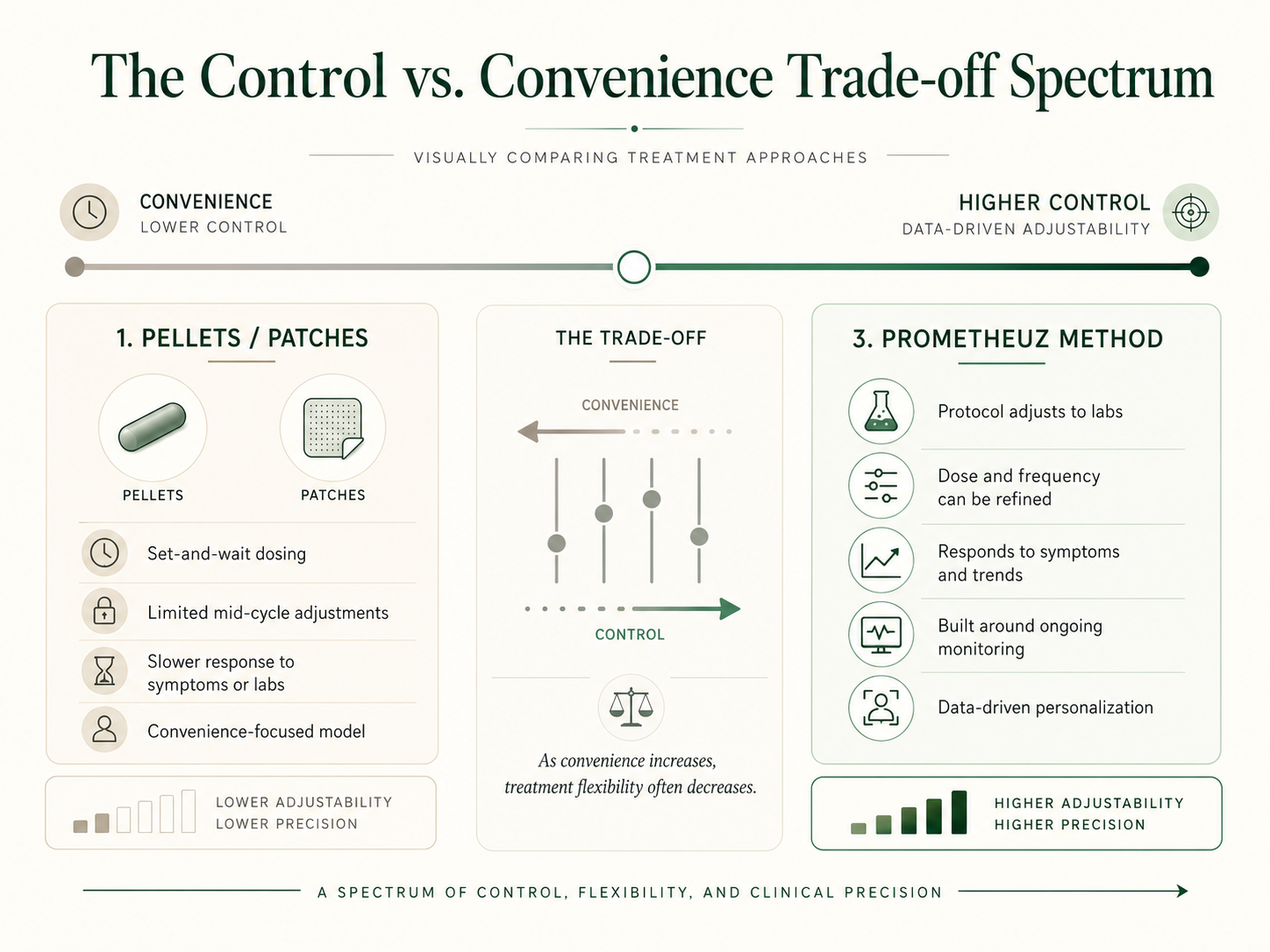
At Prometheuz, testosterone replacement therapy is built around delivery methods that can be adjusted at your next dose, not locked in for months at a time. That matters because bloodwork can shift for reasons that have nothing to do with your prescription, from body weight changes to how your body converts testosterone to estrogen. Like other transdermal options, patches deliver testosterone into the bloodstream through the skin rather than going through first-pass processing in the liver.
A delivery method your provider can fine-tune based on your labs generally means fewer surprises and fewer months spent waiting out a dose that isn't quite right. That's the reasoning behind how treatment plans here are structured, and it's worth asking any provider how quickly they can adjust your dose if your numbers change.
It's Not Patch or Pellet, It's What Your Labs Say
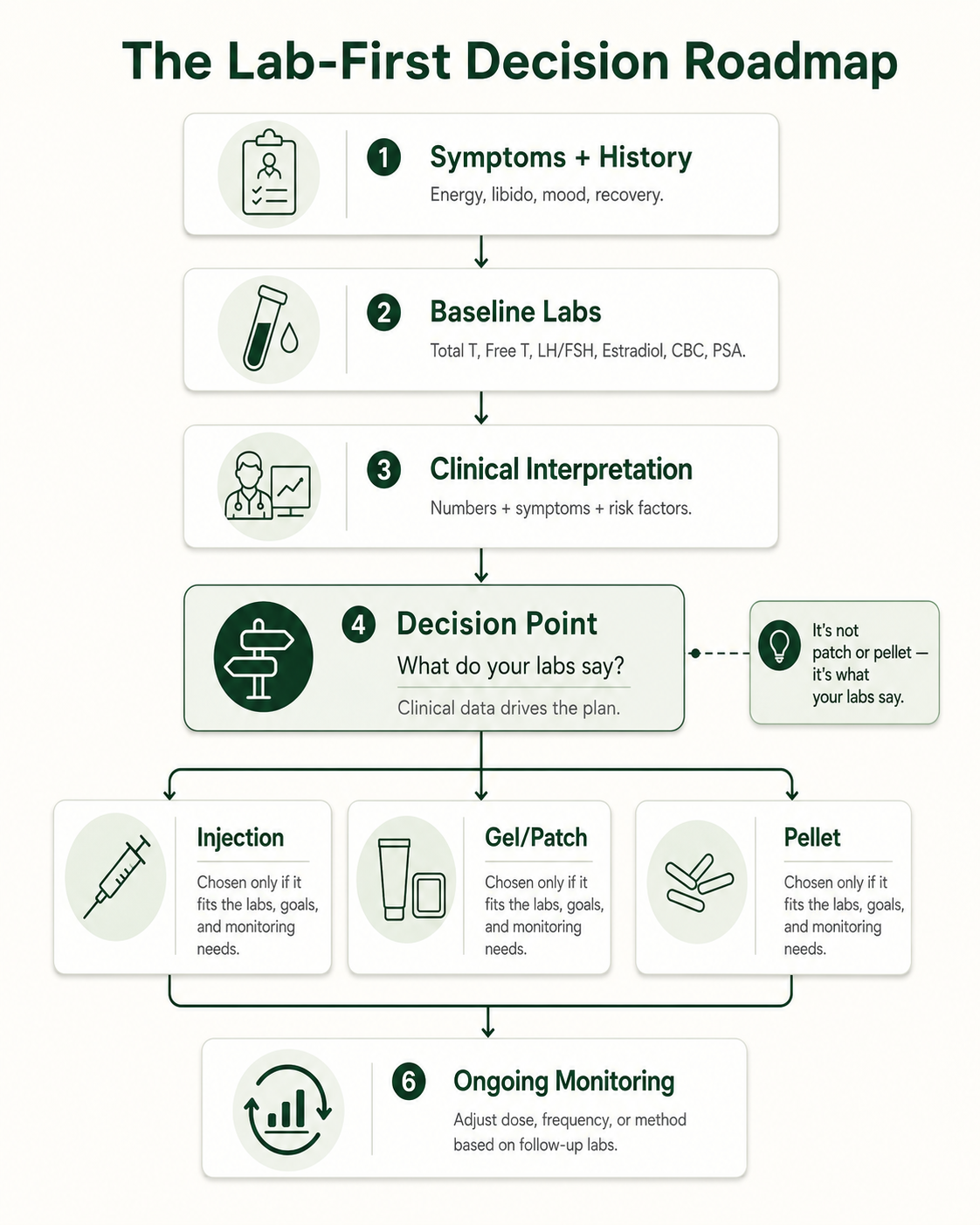
You've probably seen "patch vs pellets" framed as a simple either-or choice. In practice, one of those options barely exists anymore for men. Most men typing "pellets vs" into a search bar are really weighing pellets against injections or gels, not against a patch that's no longer on the market.
Symptom relief is the actual goal, not the delivery method itself. Weighing the benefits of convenience against the risks of an unadjustable dose matters more than picking a method just because it sounds low-maintenance. Which method fits you comes down to your baseline labs, how often you're willing to see a provider, and how much flexibility you want if something needs adjusting.
Frequently Asked Questions
Can I still get a testosterone patch in the US?
Not really. Androderm, the only FDA-approved testosterone patch, was permanently discontinued in 2023, and no generic or replacement patch has taken its place. Providers who mention "the patch" today usually mean a compounded topical cream or gel instead.
Are testosterone pellets FDA approved?
Testopel is FDA-approved. Many clinics use compounded pellets instead, which are custom-mixed by a pharmacy and are not individually FDA-approved products, even though the underlying hormone is the same.
Does getting testosterone pellets inserted hurt?
The area is numbed with local anesthetic before insertion, so most men feel pressure rather than sharp pain during the procedure. Some soreness at the insertion site for a few days afterward is common.
Can you adjust your dose once a pellet is inserted?
No. Once a pellet is placed, the dose can't be changed until it dissolves. If your levels come back too high or too low, your provider can only adjust the next insertion, not the current one.
How much do testosterone pellets cost compared to other options?
Pellet insertion typically runs several hundred to over a thousand dollars per procedure, repeated two to four times a year. Injections are usually the least expensive option per month, with gels and compounded creams falling in between.
Are testosterone pellets the same as the estrogen pellets used for menopause?
Not the same hormone, but a similar idea. Estrogen pellets and estrogen patches are common tools in menopausal hormone replacement therapy, and clinical endocrinology research supports both for hot flashes, night sweats, and other menopausal symptoms. The tradeoffs across transdermal HRT are similar too: patches allow daily, adjustable dosing, while pellets trade that flexibility for months of convenience. Unlike the testosterone patch, estrogen patches remain FDA-approved and widely available, so a woman comparing hormone patches and hormone pellets during menopause has a different set of options than a man comparing testosterone delivery methods.
What happens if my testosterone or estrogen gets too high after pellets?
Because pellets can't be removed easily, your provider will typically monitor your labs and manage side effects, like elevated hematocrit or estrogen, until levels come back down naturally. This is one reason regular bloodwork matters more with pellets than with adjustable methods.
Disclaimer
This content is for educational purposes only and does not replace medical advice. Testosterone therapy and hormone-related decisions should be guided by a licensed healthcare provider.
References
Kresch E, Lima TFN, Molina M, Deebel NA, Reddy R, Patel M, Loloi J, Carto C, Nackeeran S, Gonzalez DC, Ory J, Ramasamy R. Efficacy and safety outcomes of a compounded testosterone pellet versus a branded testosterone pellet in men with testosterone deficiency: a single-center, open-label, randomized trial. Sex Med. 2023;11(2):qfad007. doi:10.1093/sexmed/qfad007. PMID: 36936900. https://pubmed.ncbi.nlm.nih.gov/36936900/
Cheng K, Skolnick A. Testosterone pellet use in transgender men. Transgend Health. 2023;8(6):494-499. doi:10.1089/trgh.2021.0205. PMID: 38130978. https://pubmed.ncbi.nlm.nih.gov/38130978/
Wender MCO, Steiner ML, Fernandes CE, Damásio LCVDC, Soares JM, Paiva LHSD, Monteiro IMU, Quintairos RDA, Macedo CLD, Silva ALD. Compounded hormonal pellets: a critical review of current evidence and risks. Rev Assoc Med Bras. 2025. doi:10.1590/1806-9282.20250121. PMID: 40802414. https://pubmed.ncbi.nlm.nih.gov/40802414/
Ory J, Nackeeran S, Balaji NC, Hare JM, Ramasamy R. Secondary polycythemia in men receiving testosterone therapy increases risk of major adverse cardiovascular events and venous thromboembolism in the first year of therapy. J Urol. 2022;207(6):1295-1301. doi:10.1097/JU.0000000000002437. PMID: 35050717. https://pubmed.ncbi.nlm.nih.gov/35050717/
Shoskes JJ, Wilson MK, Spinner ML. Pharmacology of testosterone replacement therapy preparations. Transl Androl Urol. 2016;5(6):834-843. doi:10.21037/tau.2016.07.10. PMID: 28078214. https://pubmed.ncbi.nlm.nih.gov/28078214/